
cellenpia Elas™ Natural Rubber with CNF Started Offering Samples
~Uniform dispersion of single nano-size CNF greatly improves the strength and physical properties of natural rubber~
Nippon Paper Industries Co., Ltd.
Nippon Paper Industries Co., Ltd. (head office : Chiyoda-ku, Tokyo,President and Representative Director: Toru Nozawa, hereinafter referred to as"the Company”) is pleased to announce that it is Cellulose nanofiber a new product with a single nano-size fiber width ( "We have succeeded”cellenpia ElasTM, a rubber masterbatch that achieves both modulus of elasticity and fuel efficiency by uniformly dispersing CNF into natural rubber, which is also derived from wood components, and have started providing samples. We are planning to exhibit at "Eco Pro 2022" at Tokyo Big Sight on 12/7~9 and "Sustainable Materials (SUSMA) Exhibition)" at Makuhari Messe.
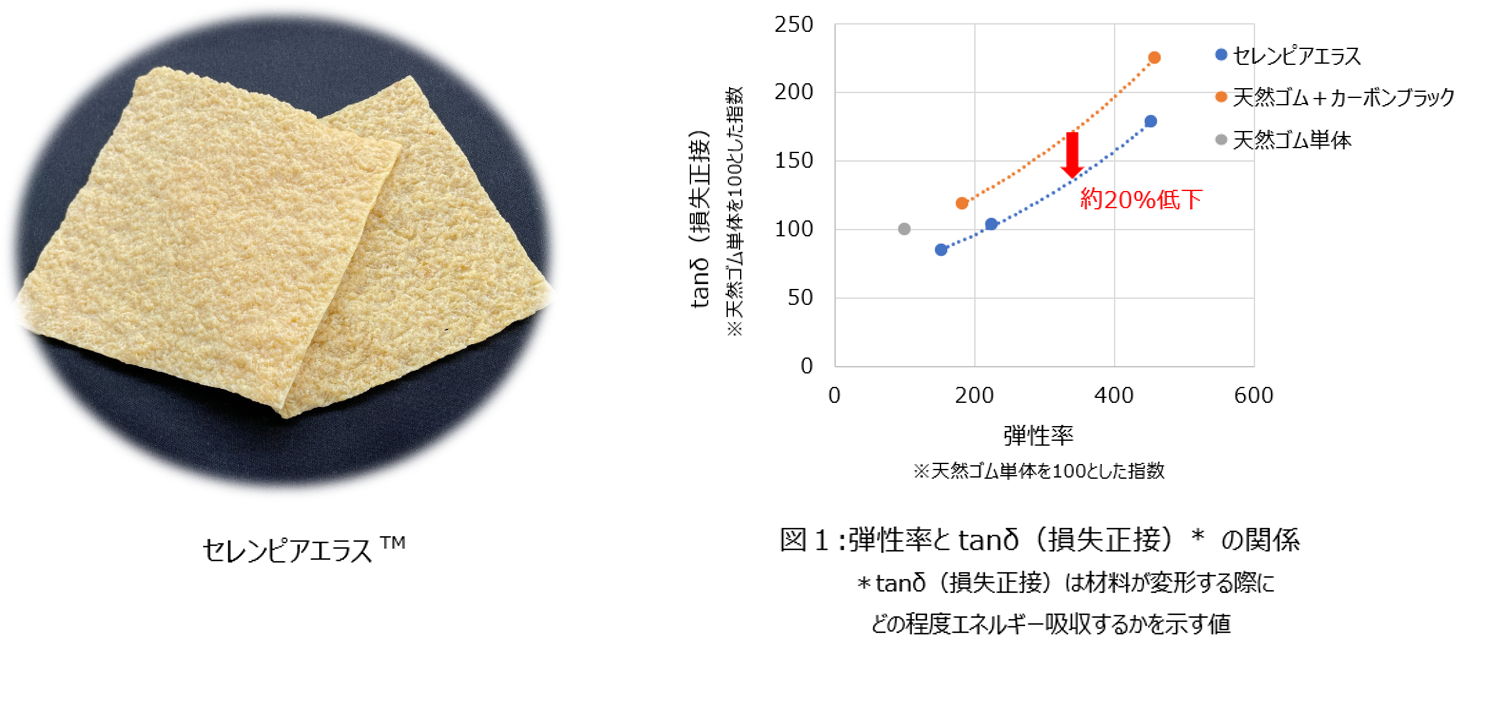
Natural rubber is a material with excellent elasticity (elongation), wear resistance, and soft properties, and is produced worldwide at a rate of approximately 14 milliontonne/year and is used in various applications such as tires, hoses, and belts. In order to increase the strength of rubber, carbon black and other materials are usually formulated, but in recent years, research has been actively conducted by industry, government, academia, and the private sector to use CNF, a renewable natural material, as a rubber additive instead of carbon black, which is a fossil fuel-derived material.
In terms of rubber and CNF mixtures, in 2019,the Companyfirst developed rubber for tires containing TEMPO oxidized CNF, a single nano-sized water dispersion, in collaboration with Sumitomo Rubber Industries., Ltd. and Mitsubishi Chemical Corporation, and Recruitment it for Sumitomo Rubber Industries.'s high-performance tires "Enersave NEXTIII" (Note 1). In addition, we are currently participating in a subsidy project (Note 2) of the New Energy and Industrial Technology Development Organization (NEDO) to reduce the cost of the manufacturing process of CNF-formulated elastomers. And this time,”the Companyhave developed"cellenpia ElasTM", which uniformly disperses CNF and rubber and provides it in the form of masterbatches. " cellenpia ElasTM”It can be directly dry kneaded with various types of rubber, and can improve the physical properties of rubber products well handled. Compared to natural rubber filled with carbon black, which is generally used in rubber materials, selenpieras reduces tanδ (loss tangent) by about 20% when the elastic modulus (hardness index) is equal, and fuel efficiency is expected to improve when used in tires and rubber belts. * *Refer to Figure 1 "Relationship between modulus of elasticity and tanδ (tangent loss)"
We produce TEMPO the Company oxidized CNF (Note 3) at the Ishinomakimillfor general industrial applications, and Carboxymethylated CNF (CM-converted CNF) (Note 4) at the Ezumillfor food and cosmetics applications, and sell them nationwide. In addition, at the Fujimill, we have developed CNF-Reinforced Resin"cellenpia Plas®”. In collaboration with Yamaha Motor Corporation, we are developing parts and providing samples to each user (Note 5). In addition to this, we have established a sample supply”"cellenpia ElasTM", which is a natural rubber containing CNF, and we have established a newinnovative materials as"a comprehensive biomass company shaping the future with trees”.・We will accelerate the creation of markets for CNFs and contribute to the construction of a plastic-reducing society and measures against global warming.
(Note 1) Nippon Paper Industries Release The world's first CNF"cellenpia ®”Recruitment in tires
https://www.nipponpapergroup.com/news/assets/pdf/news191025004604.pdf
(Note 2) "Development of Cellulose nanofiber-related technologies that contribute to a carbon-recycling society and development of CNF utilization technology that is expected to have a mass production effect" with Sumitomo Rubber Industries, Ltd.
(Note 3) CNF produced by oxidizing cellulose(raw pulp) by TEMPO catalyst and slight defibering
Very thin CNF with fiber width approx. 3nm
(Note 4) CNF produced by carboxymethylation (CM) of cellulose(raw pulp) and minor defibering
CNF with fiber width of several nm~tens of nm
https://www.nipponpapergroup.com/products/cnf/
(Note 5) Nippon Paper Industries "Yamaha Motor and CNF-Reinforced Resin Collaboration on Application Development"
https://www.nipponpapergroup.com/news/assets/pdf/news221116005347.pdf