
Adopted by Ministry of Economy, Trade and Industry "Energy and Manufacturing Process Conversion Support Project in Industries Where Reducing Emissions is Difficult"
~Project to Strengthen Competitiveness of Biomass Products by Significantly Reducing GHG Emissions at Ishinomaki Mill~
Nippon Paper Industries Co., Ltd.
Nippon Paper Industries Co., Ltd. (President & CEO: Toru Nozawa, Headquarters: Chiyoda-ku, Tokyo, hereinafter referred to as "our company") has set the 2030 Vision"reduce GHG emissions by 54% *1 compared to FY2013 ”and implement fuel conversion, energy conservation, We are working to reduce GHG emissions by promoting the reorganization of our production system.
To achieve this goal, we have applied for the government's support project "Energy and Manufacturing Process Conversion Support Project for Industries with Difficulty in Reducing Emissions ( Project II (Chemicals, Pulp and Paper, Cement, etc.))" for fuel conversion at the Ishinomaki Plant (Miyagi Prefecture) using GX Economic Transition Bonds, and it was adopted today (January 21, 2025) on the premise that we will steadily implement the strategies outlined hereafter. In the future, we will proceed with the procedure for granting subsidies through the internal approval process.
We provide society with daily necessities such as paper and paperboard from chemical pulp made from wood, which is a sustainable resource, and in order to achieve decarbonization and economic growth (GX) at the same time as carbon neutrality by 2050, we have set the goal of"Biorefinery Concept" to produce new biomass materials from chemical pulp. We are promoting business structure transformation.
We have already developed a large number of products such as dissolved pulp, which is a raw material for rayon, functional cellulose used in food additives and automotive lithium-ion battery components, admixtures for concrete, and torula yeast*2 containing high protein used in feed and organic fertilizers. We supply wood-derived biomass materials in a wide range of fields. The sales of biomass materials in various industrial raw materials such as food, cosmetics, and civil engineering have reached approximately 20 billion yen, but as our role in a carbon-neutral society, in order to ensure the realization and growth of"Biorefinery Concept", in addition to these, new biomass materials (bioethanol, cellulose nanofiber, Biocomposites, etc.).
Among them, sales of cellulose nanofibers have been steadily increasing due to the establishment of two manufacturing bases in Japan and the active promotion of sample work. In overseas markets, we have started sales in the hygiene materials and cosmetics fields, and are promoting the realization of biorefinery concepts in Japan and overseas. In addition, bioethanol, which is expected to increase in demand as a sustainable aviation fuel (SAF), automobile fuel, and green chemical raw material, has been adopted as a target for implementation of NEDO (New Energy and Industrial Technology Development Organization) "Biomanufacturing Revolution Promotion Project". We aim to scale up to tens of thousands of kL per year while assessing the business environment.
*1 Emissions related to product manufacturing, excluding the energy business
*2 Cultivated using the sugar source of hemicellulose contained in black liquor as a nutritional source
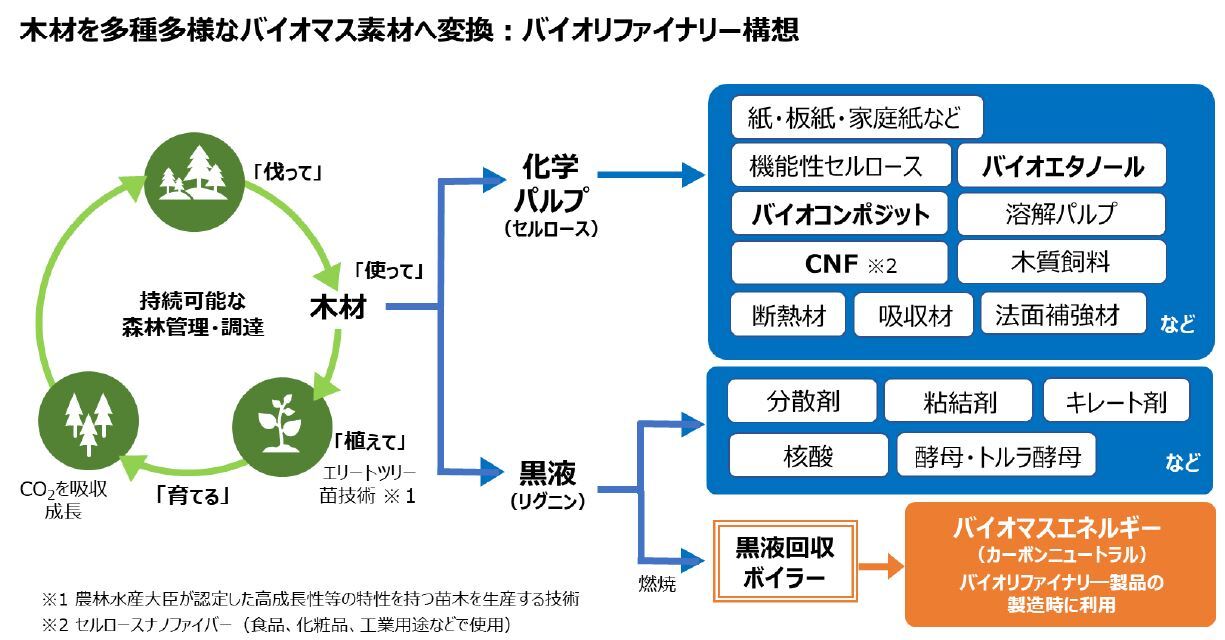
We aim to strengthen this biorefinery concept in the Tohoku region. We have already installed the largest cellulose nanofiber manufacturing facility in Japan at the Ishinomaki Plant, and this time, we will establish the foundation for the biorefinery concept by investing in fuel conversion using this support project.
At the Ishinomaki Plant, the black liquor (kokueki: biomass fuel) produced by the production of chemical pulp from wood is burned at "black liquor recovery boiler" and used as energy, but it also uses a coal boiler because it requires a large amount of steam to dry the paper. This time, we will install a high-efficiency black liquor recovery boiler, shut down one coal boiler, and switch fuel from coal to black liquor, thereby significantly reducing GHG emissions.
Currently, various markets demand products and services with low life cycle GHG emissions (LC-GHG) in addition to functionality and quality. We have also adopted LC-GHG as an important evaluation axis for joint development with brand owners who are manufacturers of final products and to develop new customers, and we are working to reduce it.
With this investment in fuel transition, we will further reduce LC-GHG not only for new biomass materials but also for existing products such as paper and household paper, and to implement LC-GHG" Visualization" in collaboration with brand owners. We will promote green products in both BtoB and BtoC aspects, and actively work to capture the market.
In the future, the Ishinomaki Plant will use this fuel transition as an opportunity to actively promote the greening of existing paper products as a manufacturing base for green products, and aim to expand its biorefinery business. By extending the results of the Ishinomaki Plant to other domestic plants and overseas bases, we will strengthen our international competitiveness, establish a solid position in the green product market in the future, and make it one of the pillars for achieving sales of 65 billion yen in new businesses set forth in the 2030 Vision.
As one of the solutions to social issues such as climate change and resource depletion, the demand for biomass materials is expected to expand significantly, but securing stable wood resources as raw materials is an important issue to strengthen supply chains. Throughout the history of paper production, we have been deeply involved in the cultivation, management, and procurement of forests in Japan and abroad, in collaboration with forestry workers, chip producers, and lumber companies. In particular, in each region, wood is "cut down", "used", "planted" and "nurtured"Through its activities, it contributes to the revitalization of the forestry industry. Strengthening the supply chain is an important issue from the perspective of resource autonomy, and we will continue to play a role in supporting the upstream side of the supply chain, while contributing to the establishment and expansion of the GX market as "Layer Master", which produces high-value-added biomass materials that are functional and environmentally friendly from chemical pulp.
■ Outline of the capital investment plan at the Ishinomaki Plant
Location: Nippon Paper Industries Co., Ltd. Ishinomaki Mill
Investment scale: 55.5 billion yen (including maximum government support: 18.3 billion yen)
Investment details: High-efficiency black liquor recovery boiler
Evaporation Capacity: 375~390t/h
Steam turbines and generators Power generation: 56~58MW
GHG Emissions Reduction*1: 500,000 t-CO2e (794,000 t-CO2e → 294,000 t-CO2e)
10% of our emissions*2
Started operation: Q4 2028
*1 Including reduction effects due to the shutdown of existing coal boilers
*2 Scope 1 and Scope 2 emissions related to product manufacturing