
Jointly developed Japan's first "Emulsion for room temperature asphalt mixture" using lignin derived from wood
~Successful practical application of a cold asphalt emulsion mixture with durability comparable to hot asphalt mixture~
TOA ROAD CORPORATION
Nippon Paper Industries Co., Ltd.
TOA ROAD CORPORATION (Headquarters: Minato-ku, Tokyo, President & CEO: Kyoichi Morishita, hereinafter referred to as "Toa Road Industry") and Nippon Paper Industries Co., Ltd. (Headquarters: Chiyoda-ku, Tokyo, President & CEO: Toru Nozawa, hereinafter referred to as"Nippon Paper Industries”) are the two companies that are the subsidiary of Nippon Paper Industries Co., Ltd. We have jointly developed "Emulsion for ambient asphalt mixture", which adopts the special modified lignin product "StarLigno®".
This product is an innovative product that can be applied to open roads while being a room temperature asphalt emulsion mixture.
Traditionally, heated asphalt mixtures with high durability and workability have been used as paving materials in road construction. However, heated asphalt mixtures need to be manufactured and constructed at high temperatures to prevent the melted asphalt from solidifying at a high temperature of about 180 degrees, and in order to save labor, reduce costs, and reduce carbon, conversion to room-temperature asphalt mixtures that do not heat was considered.
By using asphalt emulsion as a binder, the use of asphalt emulsion and other materials eliminates the need for heating processes during manufacturing, transportation, and construction, and is expected to be a technology that can significantly reduce the amount of CO2 generated compared to ordinary heated asphalt mixtures. In addition, it contributes to improving the working environment during paving during the extreme heat of recent years.
On the other hand, conventional room temperature asphalt emulsion mixtures have been used only for repairs and simple pavements due to the stability of the emulsion and the difficulty of managing it during storage, as well as the time it takes for strength to develop after construction.
In response to this problem, Toa Road Industry"will use StarLigno ®"A specially modified lignin newly developed by Nippon Paper Industries, to produce "Emulsion for Ambient Asphalt Mixtures" has been successfully developed.
As for future applications, it is highly expected to be used as a material for emergency recovery because it can be installed in islands and unpaved areas outside of Japan where infrastructure is not in place, as it does not require manufacturing equipment with heating equipment or heating work during construction, and can also be adapted to disaster recovery when local infrastructure is not functioning due to disasters.
Since its establishment in 1930 as the first company in Japan to manufacture and sell asphalt emulsions, Toa Road Industry has been involved in infrastructure development in Japan as a specialist in road construction and other areas under the corporate philosophy of"Supporting people's lives from the bottom of their feet with their own will and growth".
Since 1937,Nippon Paper Industries has been developing various lignin products that take advantage of its excellent characteristics and supplying them to the market according to the needs of the times.
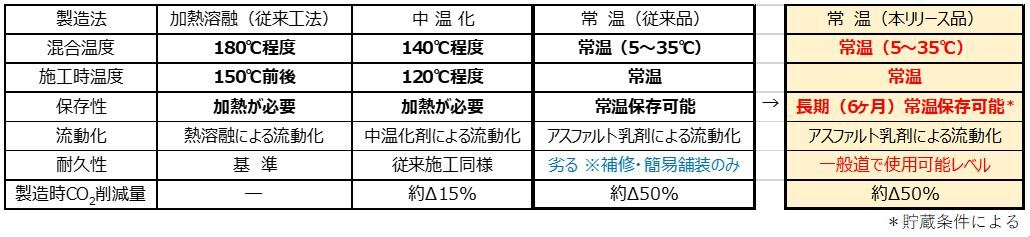
*Reference: Comparison of asphalt mixture construction methods
*"Emulsion for Ambient Asphalt Mixture" was tested for road managers of neighboring municipalities on the premises of Toa Road Industry Co., Ltd. Ibaraki Branch in Tsukuba City, Ibaraki Prefecture in November 2024, and has achieved good results.
In addition, we are currently conducting a follow-up survey to obtain construction and usability data of "Asphalt Emulsion Mixture for Ultra-Wide Area Transport" in the public call for asphalt pavement technology that can be stably supplied to a wide area conducted by the National Land Technology Research Center.
*Serviceability data: crack rate, rut digging amount, flatness indicating the degree of damage to the road pavement.
*What is lignin?
One of the main components of wood,"lignin", is a renewable polymer resource that plays a role in bonding the fibers in wood to each other, accounting for 1/4~1/3 of wood after cellulose.
*What is the special denatured lignin"StarLigno®”?
Compared to existing lignin products, it has superior dispersion and thickening performance when water dispersing various substances such as civil engineering and construction materials and dyes, and it is now possible to arbitrarily change the properties and characteristics of the dispersed slurry. In some fields of use, it has dispersibility comparable to that of petroleum-derived synthetic polymers.
*What is sulfite lignin?
The lignin produced during the production of sulfite digested pulp makes it easier to separate from the pulp by converting"Lignin" into "Sulfur lignin (lignin sulfonate)", which is soluble in water. Because lignin has the ability to dissolve in water, it has both hydrophobic and hydrophilic properties, and is used as a dispersant and surfactant in water systems.
*Sulfite digested pulp is "dissolved pulp", which is used as a material for cellulose acetate, clothing (rayon) and cellophane.