
"Research and Development of Low-Cost, High-Impact Cellulose Structural Materials" was selected for the NEDO Pilot Research Program
~TOYOTA BOSHOKU CORPORATION takes the lead and launches full-scale implementation for social implementation through industry-academia collaboration~
Toyota Boshoku Corporation
Nippon Paper Industries Co., Ltd.
Kyoto University
Kyoto City Institute of Industrial Science and Technology
TOYOTA BOSHOKU CORPORATION (Headquarters: Kariya City, Aichi Prefecture, President: Masayoshi Shirayanagi),Nippon Paper Industries Co., Ltd. (Headquarters: Chiyoda-ku, Tokyo, President: Akira Sebe), Kyoto University (Location: Sakyo-ku, Kyoto City, President: Nagahiro Minato), and Kyoto City Industrial Technology Research Institute (Location: Shimogyo-ku, Kyoto, President: Seiichi Nishimoto) are the four parties. In response to the adoption of "Research and development of low-cost, high-impact cellulose structural materials" as part of the NEDO Pilot Research Program* of the New Energy and Industrial Technology Development Organization (NEDO), we will begin joint research in earnest.
This research aims to commercialize low-cost, high-impact, lightweight, high-rigidity, and carbon-neutral structural materials using plant-derived cellulose nanofibers (CNFs) obtained from wood and other sources, which will lead to early social implementation and serve as a bridge to the next large-scale national project.
*This program aims to discover and nurture innovative technology seeds with a view to practical application and social implementation after 2040 (more than 15 years from the start of pilot research) in order to realize a decarbonized society and create new industries, and to lead to joint research through industry-academia collaboration systems, including national projects.
Background and challenges of R&D
CNF is attracting attention as an environmentally friendly material because it absorbs and fixes CO₂ in the atmosphere and has the characteristics of being lightweight and highly rigid, and is positioned as a key material for a decarbonized society. On the other hand, there are issues with high manufacturing costs, impact resistance, and moldability during parts manufacturing, which have delayed practical application of structural components, including automotive parts.
R&D Overview and Innovation
In this project, Toyota Boshoku, an automobile parts manufacturer, will be the leader, and Nippon Paper Industries Co.,Ltd., which has manufacturing technology for pulp, which is the raw material for CNF, Kyoto University, which has academic knowledge in the compounding of CNF resins, and the Kyoto City Institute of Industrial Science and Technology, which specializes in the development of molding processes for resin composites, will collaborate and promote development. We will take on the challenge of technological innovation to solve problems.
[Innovation of this project]
1) Automotive parts manufacturers lead the entire R&D with an eye on social implementation from the user's perspective
2) Convergence of world-class technologies
・Kyoto University "Cellulose Nanofiber Reinforced Resin Material Manufacturing Technology (Kyoto Process)"
・Toyota Boshoku "Nano-level shock resistance improvement technology"
3) All-in-one technology development from material development to development of construction methods suitable for materials and demonstration verification as parts
In addition, the basic technology to be built this time is not only the automotive field, but also the technological innovation of materials that are expected to be applied to various fields such as home appliances, building materials, and industrial machinery. In the future, we will establish a research promotion committee with experts and strategically promote research and development with the aim of early social implementation and development into the next large-scale national project.
[Comments from officials]
Toyota Boshoku Corporation, Materials Technology Development Department, Principal Expert, Masasei Kito
(NEDO Leading Research Program Project Leader)
In Japan, which has resource constraints, I am convinced that establishing a technology that can make advanced use of cellulose, a renewable resource, will not only lead to industrial technology development, but will also lead to "for the world and for people."
As the leader of this project, I would like to lead R&D, overcome the issues of cost and impact resistance, and be the first in the world to realize the early social implementation of CNF in structural material applications, which no one has been able to achieve before.
Nippon Paper Industries Co., Ltd. Fuji Innovative Materials Research Institute Director Toshihiko Hatakeda
NIPPON PAPER Group is "a comprehensive biomass company that opens up the future with trees" and is developing a business that utilizes renewable wood resources in multiple stages. In this project, we will expand the possibilities and deployment of CNF into industrial products, enhance social responsibility in the supply chain, and aim to realize a carbon-neutral society as soon as possible by examining the application of CNF, which is a wood resource, to structural materials centered on automotive components.
Kyoto University Institute for the Sphere of Existence Project Professor Hiroyuki Yano
CNF materials, innovative biomaterials and CNF materials that contribute to decarbonization, have not yet been put into practical use in volume zones such as automobile parts and home appliances . This project, which aims to overcome the cost and impact resistance characteristics that are barriers with the "trinity" in materials, construction methods, and structural design led by automobile parts manufacturers, is the world's first challenging initiative through cross-field vertical collaboration with an eye on carbon neutrality 2050. I am happy to be a part of that.
Kyoto City Institute of Industrial Science and Technology, Industrial Technology Support Center, Research Director, Ken Senba
Plastics are materials that contribute to reducing CO2 emissions through energy conservation through weight reduction and thermal insulation. In this project, we aim to develop and implement plastic materials that have both environmental performance and high impact resistance by combining CNF and plastics. By expanding into a wide range of fields such as automobiles, home appliances, and building materials, we will contribute to the development of Japan's plastics industry and create results that can be widely used by small and medium-sized enterprises.
[Reference] Implementation System of this Project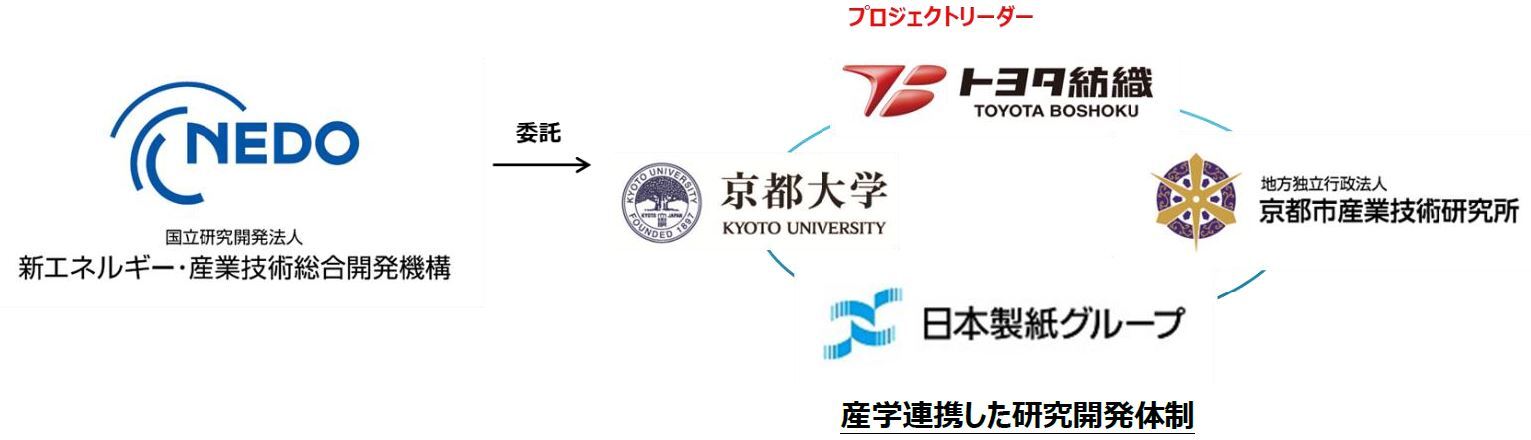
[Contact Information]
Toyota Boshoku Corporation, General Affairs Department, Public Relations Office
Tel:0566-26-0301 E-mail: yusuke.ashino@toyota-boshoku.com
Nippon Paper Industries Co.,Ltd. General Affairs and Human Resources Division Public Relations Office
Tel:03-6665-1455 E-mail:pr@nipponpapergroup.com
Biofunctional Materials Research Institute, Kyoto University
Tel:0774-38-3669 E-mail:yano.hiroyuki.86z@st.kyoto-u.ac.jp
Kyoto City Institute of Industrial Science and Technology Wisdom Industry Convergence Center
Tel:075-326-6100 E-mail:info_chie@tc-kyoto.or.jp