
Our History
NIPPON PAPER GROUP has contributed to the creation of a rich life and culture throughout its long history. We will make the most of renewable wood resources through diverse technologies and know-how and promote business development as acomprehensive biomass company.

Former Oji Paper Co., Ltd. Founding period
1873/(Meiji 6) Establishment of 'Shoshi Kaisha,' Japan's oldest paper manufacturing company.
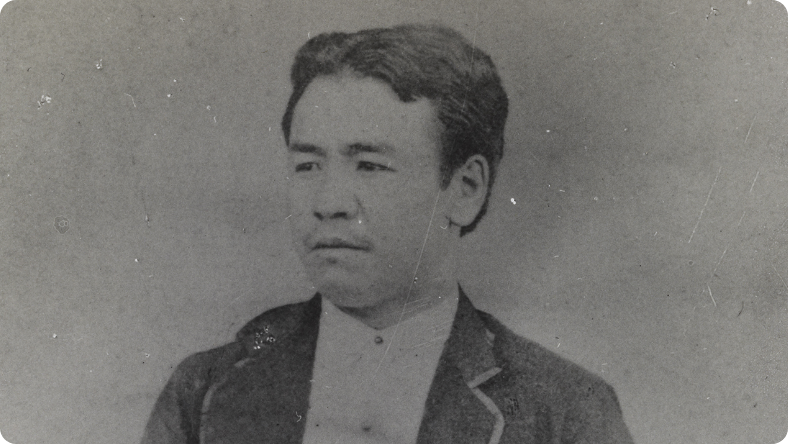
Eiichi Shibusawa keenly felt the necessity of developing Japan's paper industry during his observation tour in Europe in 1867. In 1872, he encouraged financial institutions, including the Mitsui Group, stating, "The paper manufacturing business is one that should apply Western knowledge, and while immediate profits may be small, substantial capital is required. I hope that the paper industry will be established for the sake of the nation and society." He then founded "Shoshi Kaisha" with the aim of manufacturing Western-style paper. The capital was 150,000 yen (estimated to be several hundred million to over a billion yen in current value), with the Mitsui Group being the primary investor.
Portrait of Eiichi Shibusawa(Courtesy of Shibusawa Memorial Museum)
1875/(Meiji 8) Commenced operations at the Oji Mill.
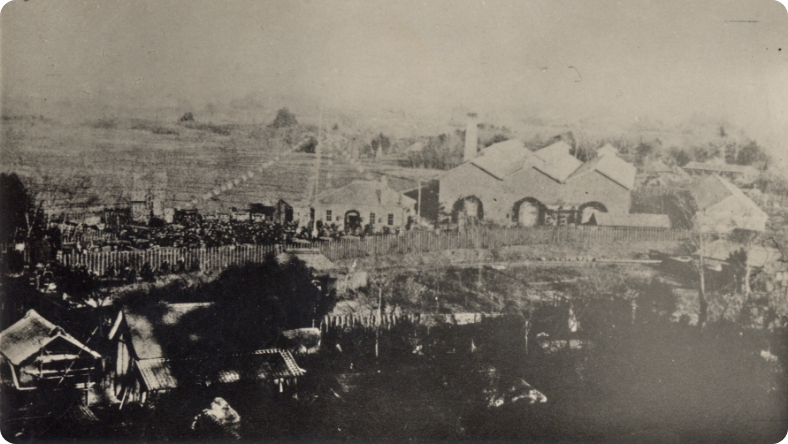
They imported the then-largest 78-inch Fourdrinier paper machine from the UK and invited foreign engineers Cheesman and Bottomley. Construction of the factory began in Oji Village, Tokyo Prefecture, in 1874. Operations initially struggled with continuous paper breaks and losses swelled to one-third of the capital, but thanks to the efforts of Shibusawa's nephew, Heisaburo Okawa, and others, conditions gradually improved, and the opening ceremony was held on December 16th of the same year.
Papermaking Company Opening Ceremony(Photo courtesy of the Paper Museum)
1876/(Meiji 9) Renamed to“Paper Company”
The company name was changed to avoid confusion with the adjacent opening of the Ministry of Finance paper making Bureau.
1877/(Meiji 10) Localization progresses
The foreign engineer returned to Japan, and Heizaburo Okawa became the head of mill management. The adoption of foreign paper for land certificates due to the land rent revision and the increase in demand for newspapers due to the Seinan War became tailwinds. With the efforts of Hoshino Tin, it won the adoption of the Asano Shimbun, and the domestic production of newsprint paper progressed.
1878/(Meiji 11) Heisaburo Okawa studied abroad in the United States.
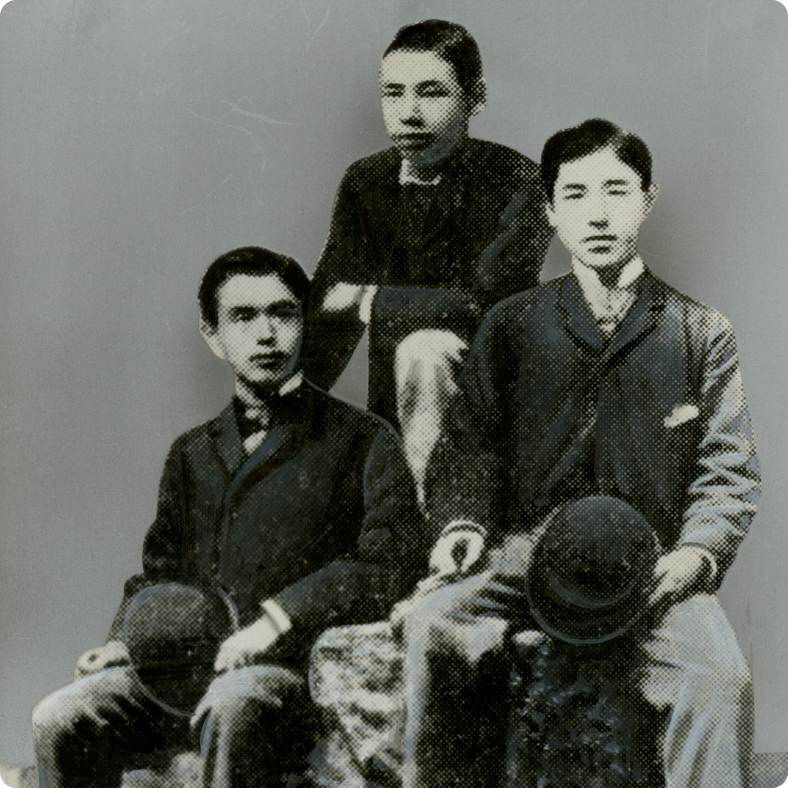
Okawa studied in Europe and the United States to research new paper raw materials, and learned technological innovations such as rice straw pulp and wood pulp manufacturing methods.
Portrait of Heizaburo Okawa(Photo courtesy of the Paper Museum)
1881/(Meiji 14) Commenced straw pulp production.
After Okawa's return, production of a new type of Western paper began, blending 60% straw pulp and 40% rag pulp, which greatly surprised the public.
1887/(Meiji 20) Commenced Japan's first Western paper production using wood pulp
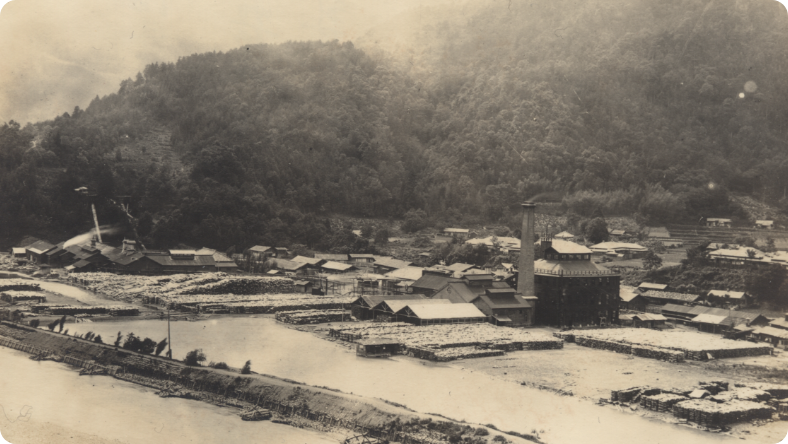
At the Keda Mill in the Tenryu River basin of Shizuoka Prefecture, production of sulfite pulp (SP) using wood as a raw material began. This established quality and cost comparable to foreign products, leading to a shift in factory locations from urban areas to mountainous regions rich in water resources and timber.
Keda Mill(Photo courtesy of the Paper Museum)
1893/(Meiji 26) Changed the trade name to“Oji Paper Co., Ltd.”
Heizaburo Okawa has been appointed as managing director.
1896/(Meiji 29) Mitsui Zaibatsu participated in management
With the increase in capital for the construction of the newmill, the major shareholder, Mitsui Zaibatsu, demanded management participation. Raita Fujiyama took over as managing director, and Okawa and Shibusawa retired and moved to management by the Mitsui Zaibatsu.
Former Oji Paper Co., Ltd. Prosperous Era
1906/(Meiji 39) Expanded into Hokkaido, constructing a newsprint factory in Tomakomai
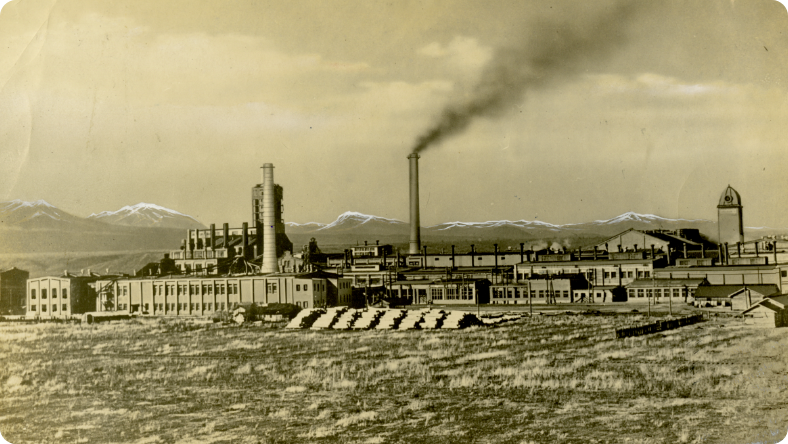
Following floods and financial losses, a large newsprint factory was constructed in Tomakomai, Hokkaido (operations began in 1910). However, management deteriorated due to the post-war recession, and Ginjiro Fujiwara of Mitsui & Co. was appointed managing director in 1911 to rebuild the company. He promoted rationalization and talent acquisition.
Tomakomai Mill(Photo courtesy of the Paper Museum)
1914/(Taisho 3) Expansion of business and oligopoly by Oji, Fuji, and Kabata
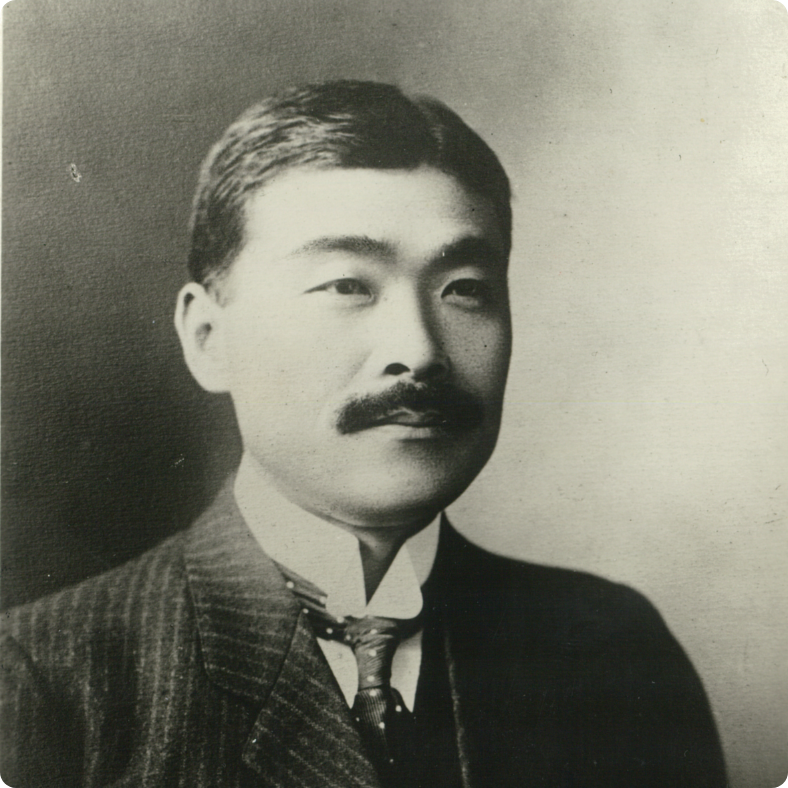
During World War I, which began in 1914 (Taisho 3), the paper and pulp industry experienced a boom, leading to the proliferation of many small and medium-sized paper companies. However, the post-war depression made it difficult for these companies to survive. Under the leadership of President Ginjiro Fujiwara, Oji Paper expanded its business by acquiring and merging these struggling companies, establishing an oligopoly alongside Fuji Paper and Kabata Industries.
Portrait of Ginjiro Fujiwara (Photo courtesy of the Paper Museum)
1933/(Showa 8) The merger of the three companies led to the birth of "Dai-Oji Seishi"
Due to over production and recession due to expansion competition, and the impact of Canadian dumping, the three companies of Oji, Fuji, and Kabata merged (the merger ratio is Oji 100, Fuji 145, and Kabata Kogyo 245). The global“Paper made by the Dai-Oji Seishi”was born, accounting for 85% of the domestic share. By rationalization, it paid off its huge debt (300 million yen at the time) in three years, and in Showa 11, it became a huge company with a capital of 300 million yen.
Fujiwara Ginjiro and social contribution Fujiwara made large donations to major universities with his own money and company funds, and established Fujiwara Institute of Technology (now Keio University's Faculty of Science and Engineering) and the Fujiwara Science Foundation, making significant contributions to the promotion of science and technology in Japan.
From the Post-War Period, the Zaibatsu was Dismantled
1949/(Showa 24) Due to the dissolution of zaibatsu, the company was split into three: Jujo Paper (our company), Tomakomai Paper, and Honshu Paper.
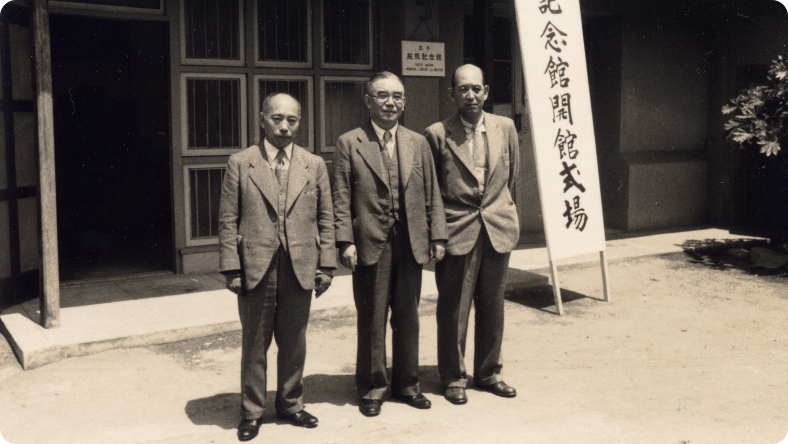
After World War II, under the Excessive Economic Power Deconcentration Law, the former Oji Paper was dismantled and split into three companies: Tomakomai Paper (later Oji Holdings), Jujo Paper (our company), and Honshu Paper. Jujo Paper inherited seven factories and the Oji Paper Research Institute. Under its first president, Wataru Nishi, the company pursued democratic management and increased production, becoming the industry leader in production volume by 1952.
Presidents of Jujo Paper, Tomakomai Paper, and Honshu Paper attending the opening ceremony of the Paper Memorial Museum (Photo courtesy of the Paper Museum)
Establishment of Nippon Paper Industries
1993 (Heisei 5) Jujo Paper Co., Ltd.and Sanyo-Kokusaku Pulp Co., Ltd merge
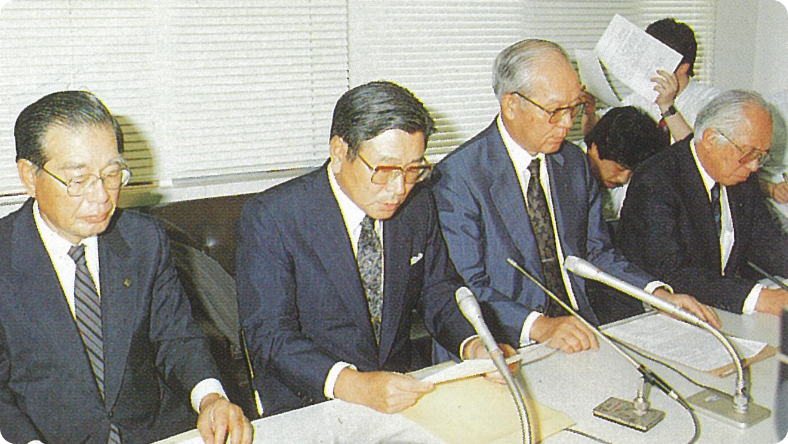
Integration of Jujo Paper Co., Ltd.and Sanyo-Kokusaku Pulp Co., Ltd, establishment of Nippon Paper Industries in order to improve the profit structure during the recession, Jujo Paper Co., Ltd., which ranks third in the industry, and Sanyo-Kokusaku Pulp Co., Ltd, which ranks fifth, merged, the industry's largest“Nippon Paper Industries” with sales of about 700 billion yen was born. The symbol “Dynawave”was also established.
Photo: Presidents of both companies announcing the merger
New Nippon Paper Industries
2001-2003 Business Integration and Merger of Three Companies
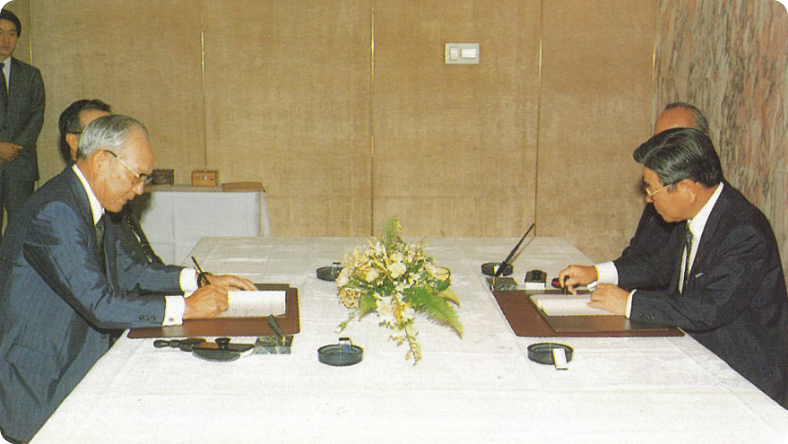
In 2001, the company integrated its management with Daishowa Paper and transitioned to a holding company system. In 2003, Nippon Paper Industries, Daishowa Paper, and Nippon Kami Kyohan merged to restart as "Shinsei Nippon Paper". It became the top company in the Western paper industry with a production capacity of 6 million tons and sales of 650 billion yen.
Photo: Signing the memorandum of understanding for the merger at Tokyo Kaikan
2005 - 2009 Accelerated global expansion
The "Group Vision 2015" was formulated, and in 2009, as part of its expansion into the Asia-Oceania market, the company acquired all shares of Australian Paper.
2013 (Heisei 25) Nippon Paper Industries was established as a business holding company.
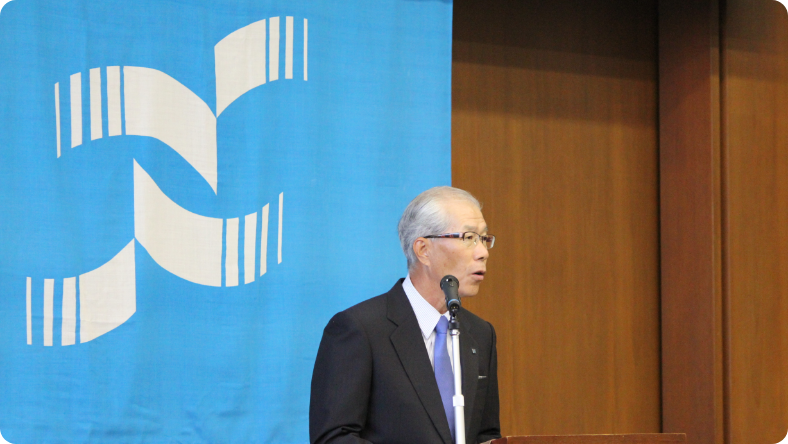
To overcome a challenging business environment, the company transitioned to a flat organizational structure as a business holding company. The aim was to enhance group unity and create new growth opportunities.
Photo: President Haga giving a speech at the merger ceremony.
2015 - 2021 Transformation into a comprehensive biomass company
In 2015, we established the Slogan “a comprehensive biomass company shaping the future with trees”and began to business structure transformation. In 2021, we announced“2030VISION”.