
Response to Climate Change
Climate change is an urgent social issue on a global scale, with a significant impact on our society and economy. NIPPON PAPER GROUP believes that it is its responsibility as a comprehensive biomass company to face this important social issue seriously and contribute to its solution.
In addition to reducing greenhouse gas emissions from our business activities, we will actively act to solve climate change issues in cooperation with our suppliers, local communities, and other stakeholders through the appropriate management, development, and utilization of forest resources, the introduction of renewable energy, and the development of innovative technologies and products.
Basic Policy
The Group has set "Respond to drastic changes in social conditions, such as GHG reduction and other environmental issues" as one of its basic policies of "NIPPON PAPER GROUP 2030VISION," and is working on greenhouse gas (GHG) reduction and Green Strategy to achieve carbon neutrality by 2050.
In order to implement the basic policy, we have set numerical targets for GHG reduction and CO2 absorption through appropriate forest management in “NIPPON PAPER GROUP Environmental Targets 2030”, and are working to achieve these goals.
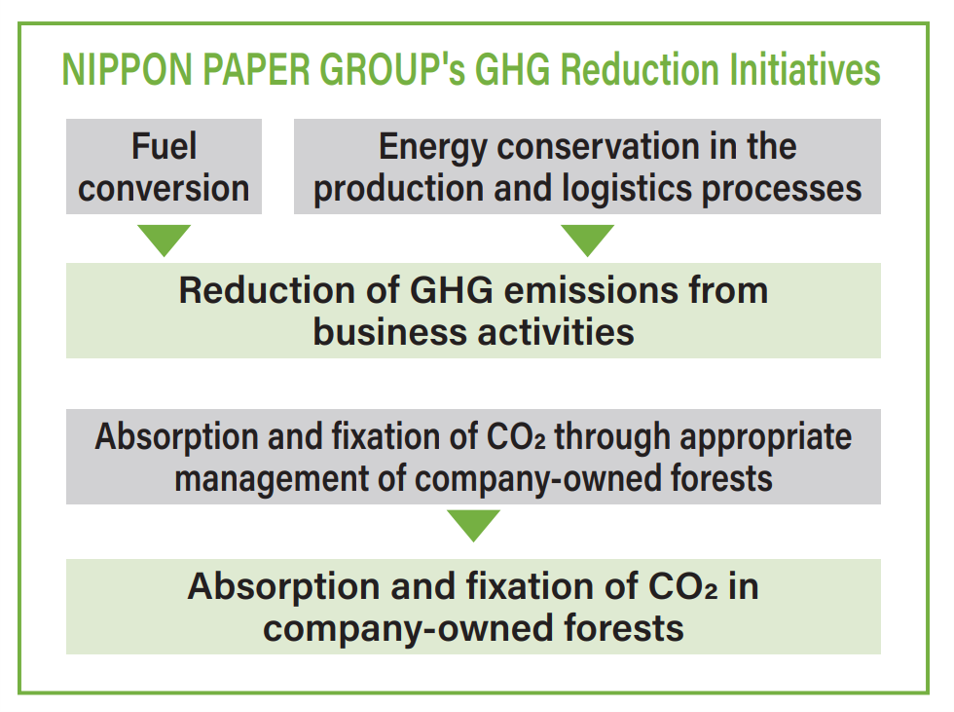
Nippon Paper Industies' main business, the pulp and paper industry, is an energy-intensive industry and is greatly affected by transition risk due to the introduction of carbon pricing and energy policies. In order to reduce this impact, the Group has accelerated GHG reduction measures, established a system for constantly monitoring policies and market trends, identifying and evaluating risks, and incorporated them into the Group's environmental management promotion structure to link with the Group's management strategy.
Scenario Analysis
Based on the TCFD recommendations, the Group conducts qualitative and quantitative assessments of the impact of climate change risks and opportunities on its financial plan as of 2030 and 2050 using two scenarios (1.5°C scenario and 4°C scenario) that assume rising temperatures.
In a 1.5°C scenario where temperature rise is relatively moderate, transition factors such as the introduction of climate change policies and changes in market needs pose a major risk. On the other hand, in a 4°C scenario where the temperature rises rapidly, physical factors such as an increase in extreme weather and severe disasters are also a major risk. In response, the Company will avoid risks and ensure strategic resilience by reducing GHG Emissions as soon as possible through energy-saving measures and fuel switching.
On the other hand, in both scenarios, the introduction of climate change policies and changes in market needs will create and expand markets for ethical consumption and biomass and environmentally friendly products, and there are many opportunities for us to enter the market and grow by leveraging our strengths. In addition, since adaptation to climate change, such as preparing for severe disasters, is considered essential to some extent, the growing demand for adaptive products such as disaster prevention hygiene products and long-term storage paper cartons will also be an opportunity for growth in the Group.
Risks and Opportunities
Risks and business opportunities based on scenario analysis are evaluated, including the financial impact and the impact on the Company due to market expansion.
Climate Change-Related Risks
Risks as of 2030
* Amount of impact: less than 10 billion yen (Low), 10 billion yen or more but less than 50 billion yen (Medium), 50 billion yen or more (High)
Qualitative evaluations, except for those marked with "*"
Carbon prices are set based on the IEA's NZE (Net Zero Emissions) scenario
Opportunities for Business Expansion
Opportunities as of 2030
Indicators and Targets
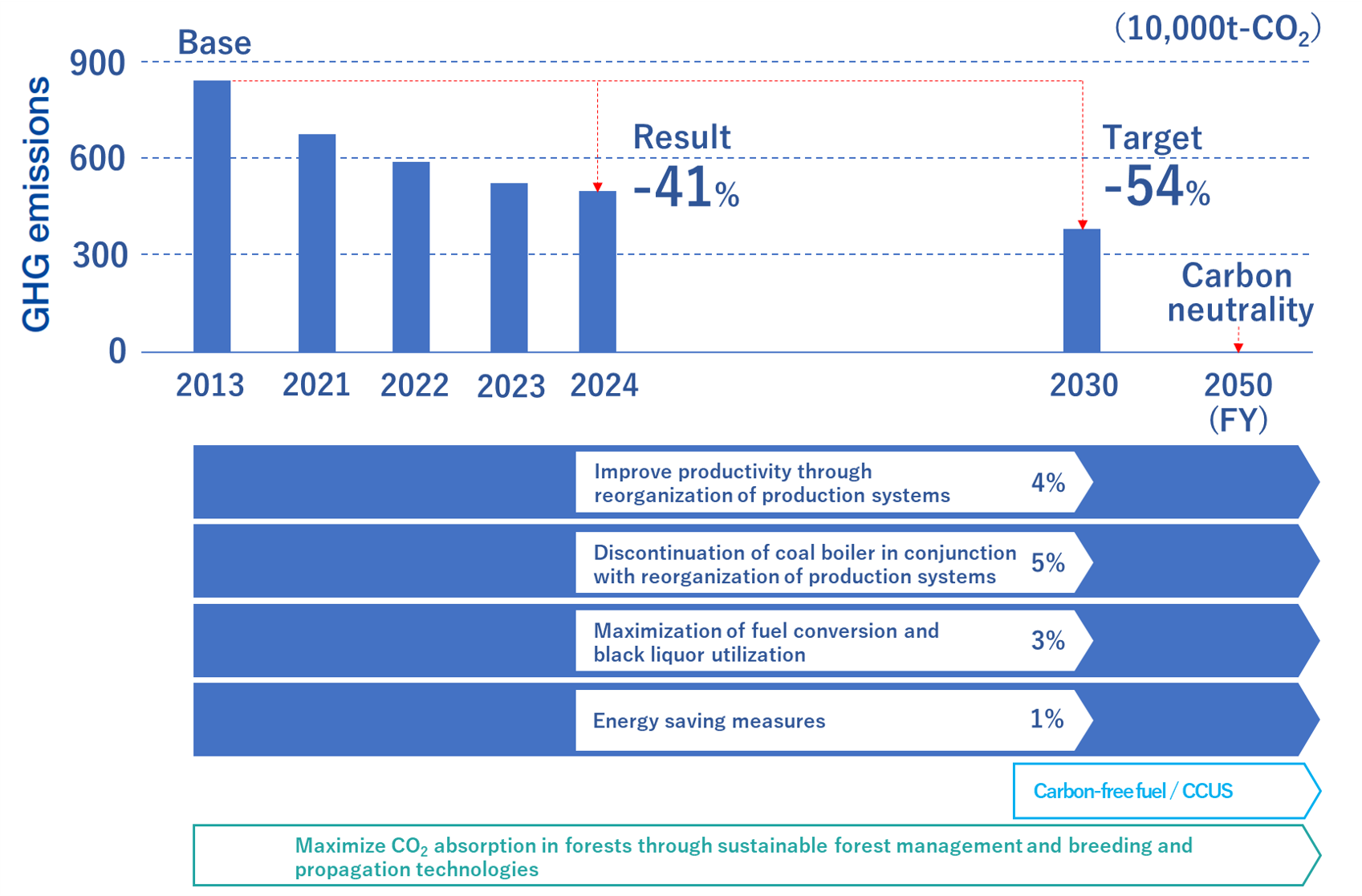
The Group has declared that it will achieve carbon neutrality by 2050 as a long-term goal, and has set a medium-term target to reduce GHG Emissions (Scope 1+2) by 54% in FY2030 compared to FY2013* as a milestone for reduction. Since FY2021, when we set medium-term targets, we have been actively working on energy-saving and fuel conversion, resulting in a reduction of 41% in FY2024.
*Emissions related to production except for the Energy Business field
NIPPON PAPER GROUP GHG Emissions (FY2024)
Emissions related to production except for the Energy Business field
Market-based approach
Emissions boundaries and emissions by category
Scope1, Scope2
Scope3
Energy-Saving Initiatives
At our Iwakuni Mill, we are working to prevent heat stroke among employees and prevent wastepaper spoilage by changing the air conditioning equipment in the coater finishing room from the existing absorption chiller to a higher-performance turbo chiller to create a more comfortable working environment with less energy consumption, and as a measure to adapt to climate change. This initiative is expected to improve energy efficiency by 88% compared to before the renewal and reduce CO2 emissions by approximately 2,000 tons per year.
Fuel Conversion Initiatives
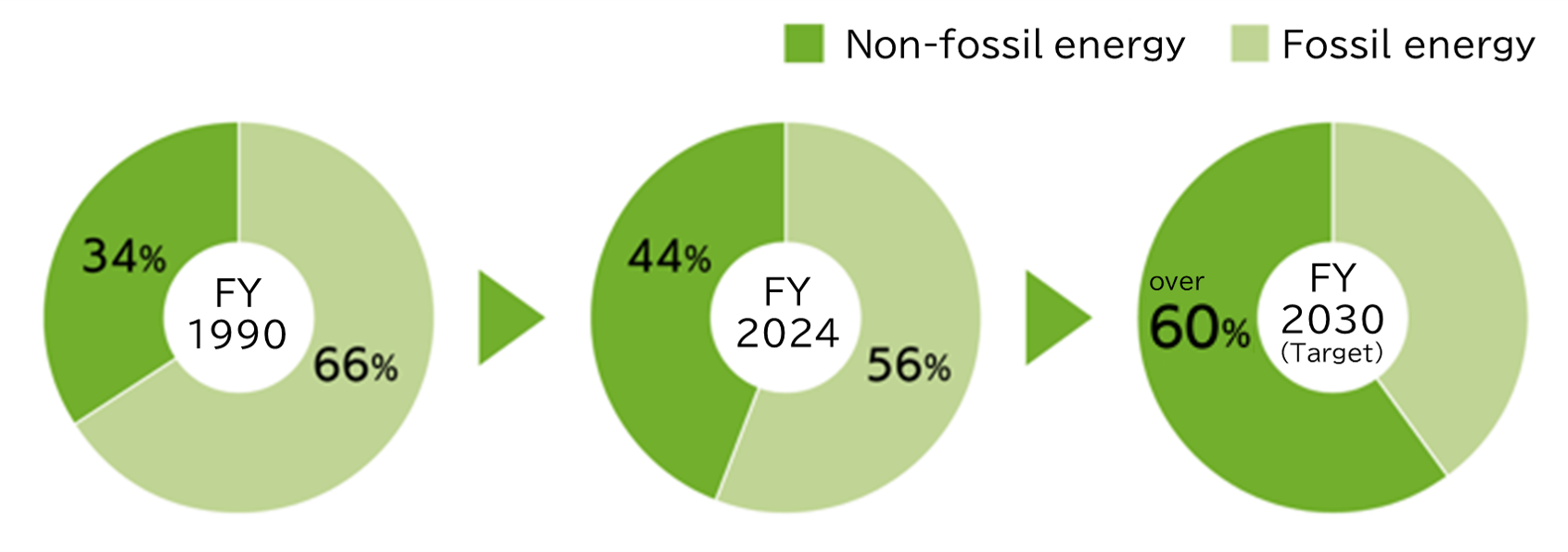
The Group has set a target of reducing the proportion of non-fossil energy in its energy use to 60% or more in order to reduce the use of fossil fuels such as heavy oil and coal. We actively use woody biomass fuels such as black liquor and construction waste, which are produced as by-products during pulp production, as well as waste fuels such as used tires and RPF*. In addition, Nippon Paper Crecia has installed solar power generation equipment at each mill under a PPA (Power Purchase Agreement).
As a result of actively promoting the transition from fossil to non-fossil fuels, the ratio of non-fossil energy in FY2024 was 44%.
*Refuse derived paper and plastics densified fuel: High-grade solid fuels mainly made from wastepaper and waste plastics, which are difficult to recycle among industrial waste materials
Ratio of Non-Fossil Energy to Total Fuel Used (calorific equivalent)
Case Study:Investments in Equipment for High-Efficiency Black Liquor Recovery Boiler (Nippon Paper Industries Ishinomaki Mill)
At our Ishinomaki Mill, we are implementing a fuel conversion project that involves shutting down one coal boiler and significantly reducing GHG emissions by installing a high-efficiency black liquor recovery boiler. This project has been approved by the Ministry of Economy, Trade and Industry of Japan "Energy and Manufacturing Process Conversion Support Program for industries in hard-to-abate sectors". This will reliably reduce transition risk related to climate change, and at the same time, by providing biomass materials with low GHG emissions during manufacturing to society along with environmental value, we will work to "create green markets" and aim for the simultaneous realization of decarbonization and economic growth (GX).
〈Overview of the Capital Investment Plan〉
At time of adoption
Including reductions from the discontinuation of the existing coal boiler
Emissions related to production except for the Energy Business field
Case Study:In-house Production of Solid Fuel from Waste (Nippon Paper Industries Otake Mill)
At the Company’s Otake Mill in Otake City, Hiroshima Prefecture, paper sludge*1 and wastepaper residues*2 generated in the production of containerboards are solidified within the mill and used as fuel. Since April 2019, the mill has also accepted and utilized plastic waste produced in Otake City. In-house production and use of waste fuel are beneficial not only by reducing coal consumption and contributing to regional shift to carbon neutrality, but also by extending the lifespan of final waste disposal sites.
A sludge produced in the manufacture of paper, containing mainly cellulose fibers and minerals drained during the paper dewatering/drying process
Foreign matter produced when processing wastepaper
Case Study:Biomass-fired Power Generation Facility (Yufutsu Energy Center)
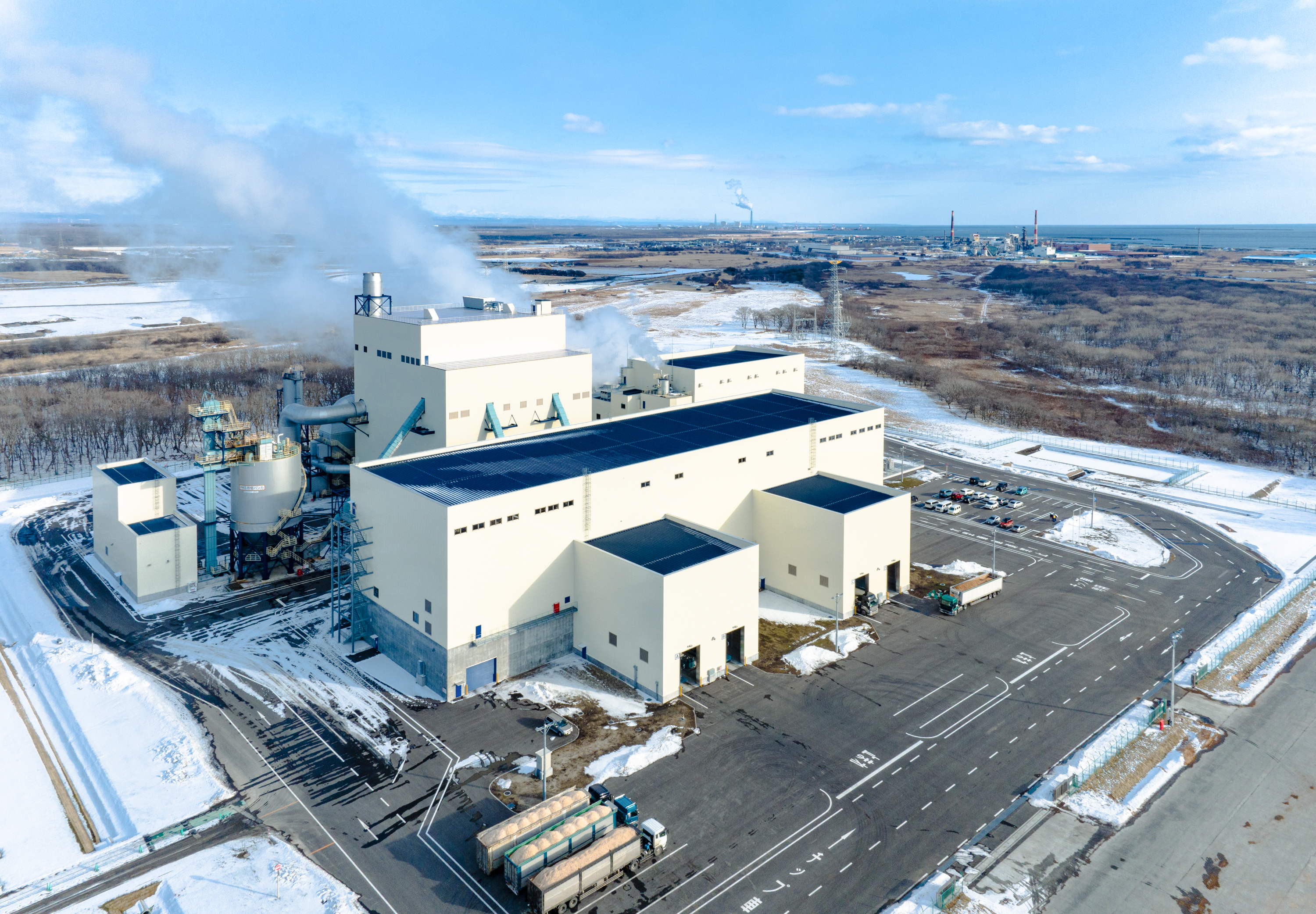
The Yufutsu Energy Center, one of the largest biomass power generation facilities in Japan, began operation in February 2023 and continues to operate smoothly. As fuel, we use wood chips, PKS (palm shells), and unused wood such as forest residues generated in Hokkaido. In addition, Nippon Paper Ishinomaki Energy Center Ltd. has carried out a biomass high-co-firing remodeling project (completed in December 2023), which has been able to increase the biomass ratio from 26% to 42%. This contributes to the reduction of GHG Emissions.
Development of Environmentally Friendly Products
The Group is working to provide materials and products with low environmental burden throughout the entire product life cycle.
Case Study:Environmentally Friendly Products “N.Polaris43Mocha”
Magazine body paper is made by grinding wood by machine, known as "mechanical pulp," which has the characteristics of light weight, high volume, and resistance to ink bleed-through. However, mechanical pulp uses a lot of energy during production, leading to higher GHG Emissions compared to "chemical pulp," which is produced by extracting wood fibers through chemical treatment.
"N.Polaris43Mocha" is a magazine body paper that achieves 100% chemical pulp while maintaining the quality characteristics of conventional products, thanks to the Company's unique bulk technology and ink bleed-through prevention technology. As a result, we have reduced GHG Emissions by approximately 20% throughout the entire life cycle compared to conventional products*.
*Assuming that the manufacturing conditions of the Company's conventional products and N.Polaris43Mocha are the same, the estimated life cycle GHG emission reduction when only the pulp mixture ratio is changed.
Initiatives in the Logistics Processes
In addition to reducing GHG emissions in the manufacturing process, the Group is also working on green logistics that leads to the reduction of GHG Emissions in the logistics process, with "Improved loading efficiency" and "Reduced transportation distance" as its two pillars.
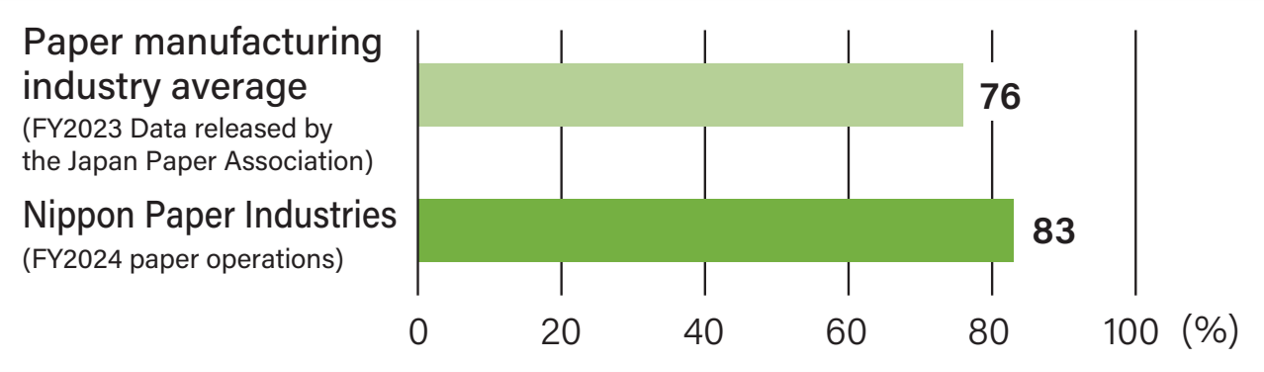
By promoting modal shifting, which converts freight transportation carried by trucks and other automobiles to the use of railways and ships that can transport large quantities of cargo over long distances at once, the modal shift rate in the Company's paper division is 83%.
In addition, by collaborating across industries, we are working to expand consolidation and further modal shifts.
Comparison of Modal Shift Rates
Case Study:Started Modal Shift Consolidation Transport with NISSIN FOOD PRODUCTS
In FY2024, the Company started modal shift consolidation transport with NISSIN FOOD PRODUCTS CO., LTD. ("NISSIN FOOD") to transport both roll paper and instant noodles in the same cargo between the Tokyo metropolitan area and the Kansai area. Before the initiative, products were transported to the Kansai area by each company's truck. Now, roll paper is loaded into containers at the Nakoso Mill first, and then instant noodles are loaded at the NISSIN FOOD PRODUCTS Kanto Plant. These products are transshipped to a domestic vessel provided by UTOC LOGISTICS CORPORATION and transported by sea from Tokyo Port to Osaka Nanko Port. With this shift, the Company will contribute to creating a sustainable society while reducing GHG emissions from transport by both companies and addressing the "2024 problem" (of reduction of transport capacity expected to result from regulations set to take effect in Japan that year) in the logistics industry, such as the diversification of transport methods.
More information can also be found in the PDF material below.