
Reduction of Environmental Burden
Under the philosophy of “NIPPON PAPER GROUP Environmental Charter," the Group is actively working to reduce environmental burden in order to realize a sustainable society as well as comply with environmental laws and regulations.
In addition to introducing an environmental management system, we are working to meet the expectations of society and stakeholders, and to further reduce environmental burden and minimize risks by establishing a system that can prevent environmental pollution and respond quickly and appropriately in the event of a risk occurring.
Efforts to Reduce Environmental Burden (Typical 7 Pollution)
(1) Reduction of Atmospheric Environmental Burden
The Group is implementing a variety of advanced measures to reduce emissions of air pollutants such as NOx (nitrogen oxides), SOx (sulfur oxides), and dust. Each production mill is implementing multifaceted initiatives such as the introduction of environmental burden reduction equipment, optimization of fuel conversion and combustion methods, installation of desulfurization and denitrification equipment, appropriate operation management of dust collectors, and reduction of fuel consumption by exhaust heat recovery.
The Group manages air pollutant emissions at levels consistently below the standard values set by laws and regulations and agreements with local governments.
In addition, the Group has set a target of reducing air pollutants by 15% compared to FY2018 in "NIPPON PAPER GROUP Environmental Target 2030", and achieved a 50% reduction in SOx, 26% in NOx, and a 27% reduction in dust in 2024, significantly exceeding its targets. The Group will continue to strive to further reduce its environmental burden through a thorough management system.
(2) Reduction of Water Quality Environmental Burden
The Group is implementing various measures to reduce emissions of water pollutants such as COD (Chemical Oxygen Demand), BOD (Biochemical Oxygen Demand), SS (Suspended Solids), total nitrogen, and total phosphorus, including appropriate operation management of wastewater treatment facilities and water recycling. Wastewater is discharged into public water bodies and sewers after undergoing advanced purification treatment such as activated sludge treatment facilities to reduce organic substances to levels below the standard values set by laws and regulations and agreements with local governments.
In addition, the Group is actively working to reduce water intake and promote water conservation measures. In "NIPPON PAPER GROUP Environmental Target 2030", the Group has set a target of reducing water pollutants by 15% compared to FY2018, and in FY2024, the Group achieved a 35% reduction in COD/BOD and a 17% reduction in SS, significantly exceeding its targets. The Group will continue to strive to further reduce its water quality burden through a thorough management system.
Case Study:White Water Recycling
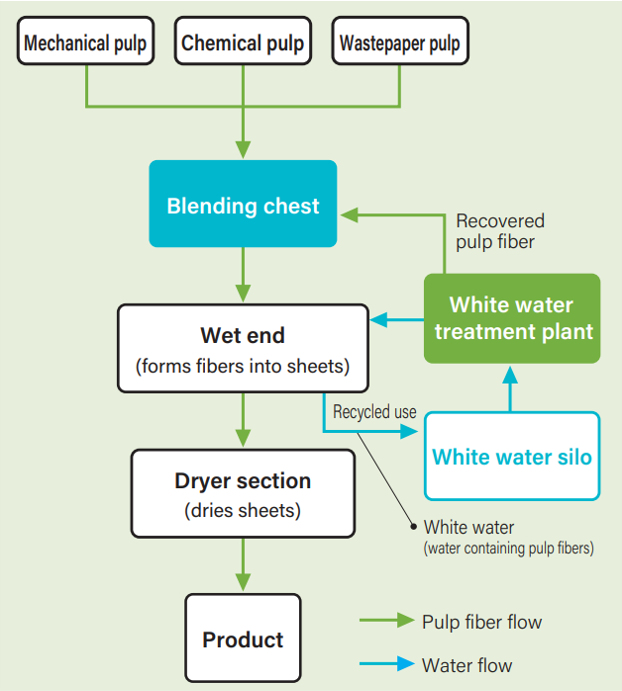
At the Group’s paper mills, they collect water containing fine pulp fibers generated in the wet end called white water. The collected white water is separated into pulp fibers and reused water by the treatment equipment, the pulp fibers are returned to the blending chest and the reused water is returned to the wet end for recycling, in an effort to reduce water consumption.
White Water Circulation Flow Diagram
(3) Efforts to Prevent Noise and Vibration
The Group has introduced sensor equipment that can automatically detect signs of equipment abnormalities for noise and vibration generators at each mill and office. By utilizing IoT technology, noise and vibration can be monitored in real time, enabling early detection and prevention of abnormalities.
Case Study:Development and Introduction of "e-musen junkai™ " (e-wireless patrol) System (Nippon Paper Industries, NIPPON PAPER UNITEC, and Sakurai)
"e-musen junkai™" is a facility monitoring system developed independently by the Group. In the past, signs of equipment abnormality were mainly detected by people patrolling the production site. By using "e-musen junkai™," temperature and vibration acceleration data of machinery in operation are collected wirelessly, and trends can be monitored with graph data. This helps to prevent sudden stoppages caused by equipment problems for stable machinery operation and further contributes to resolving labor shortages by reducing the burden on on-site workers. While being successively introduced to all the Company mills in Japan, the system has been adopted by a growing number of companies outside the Group, including major automotive and textile companies. The Company has also obtained wireless certification and begun sales in Thailand.
(4) Initiatives to Prevent Soil Contamination
The Group has a system that ensures that the raw materials and chemicals used at each mill and business site contain almost no soil contaminants such as heavy metals and trichloroethylene. In addition, strict management and regular inspections prevent any impact on the soil environment.
(5) Odor Prevention Initiatives
The Group takes appropriate measures against the sources of odor-causing substances such as hydrogen sulfide and methyl mercaptan. Some mills have also implemented odor sensors to monitor odors in real time to minimize the impact on the surrounding environment.
(6) Initiatives to Prevent Land Subsidence
When taking groundwater, the Group strictly adheres to the amount of water intake set by each local government and strives to prevent ground subsidence. In addition, the Group is working to preserve the local ground environment by thoroughly managing the water surface.
Efforts to Reduce Environmental Burden (Industrial Waste)
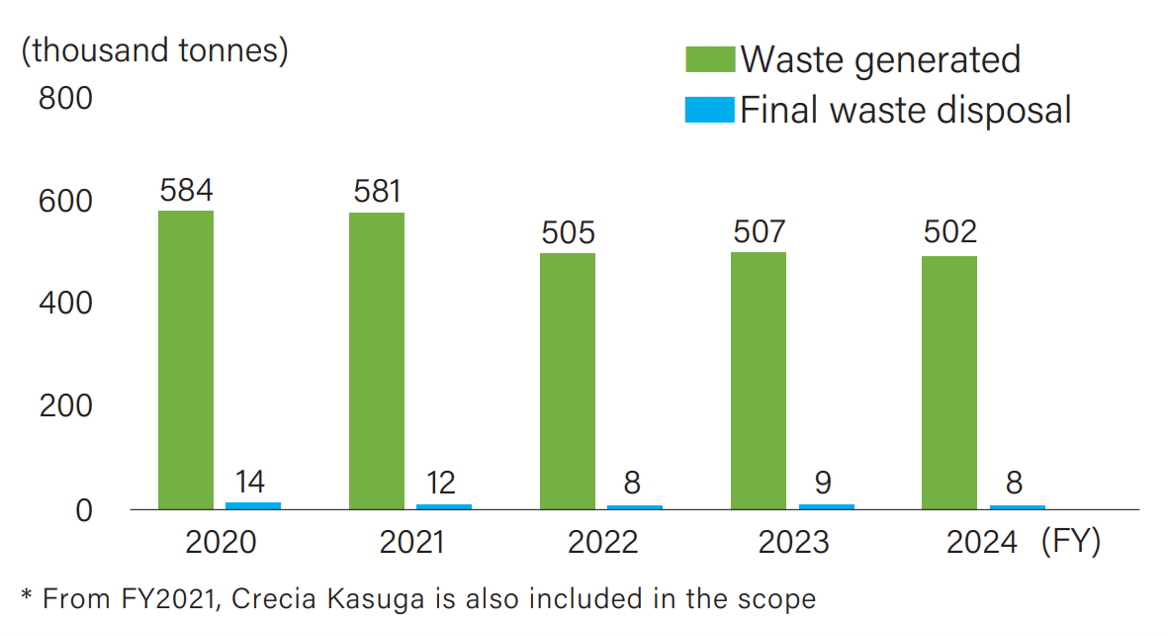
The Group has set a goal of reducing the final disposal of industrial waste at domestic production sites to less than 2% in "NIPPON PAPER GROUP Environmental Targets 2030" and is actively working to reduce waste generation and recycling. In FY2024, the final disposal volume of industrial waste at domestic production sites was 1.6%, and the Group achieved its target.
Waste Generated and Final Waste Disposal (in Japan*)
Chemical Substance Management
In accordance with "NIPPON PAPER GROUP Chemical Substance Guidelines", the Group conducts internal audits of chemical substances used in the manufacturing process of products and implements risk management to monitor the amount of chemical substances used and the amount of emissions and transfers to the environment. The Group also takes corrective action as necessary.
In the risk communication held at each mill and office, the amount of chemical substances emitted and transferred under the PRTR system is disclosed to local stakeholders.
More information can also be found in the PDF material below.