
Overseas Plantation
Sustainable Forest Management
Plantation Business that Coexists with the Local Community
NIPPON PAPER GROUP believes that it is important to build good relationships with the local communities around the plantation areas and to develop together. In forest management, based on “Principles and Basic Policies Concerning Raw Materials Procurement,” we take into account the local residents, local culture and traditions, and the natural environment and ecosystem. It also contributes to the local economy by creating jobs and supporting educational activities.
Plantation Business in Consideration of Local Ecosystems
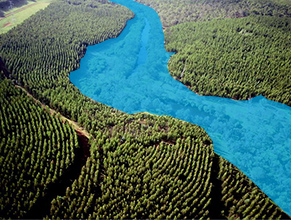
The Group utilizes grasslands, former farm and pasture sites, and areas where planted trees have been felled as reforestation sites. We also select and plant tree species suitable for the local climate and papermaking raw materials, primarily focusing on fast-growing eucalyptus. To balance the mass planting of eucalyptus with the maintenance of biodiversity in the area, we take appropriate measures, such as preserving native vegetation along rivers, which have a significant impact on the ecosystem, as riparian forests.
Representative Overseas Plantation Business
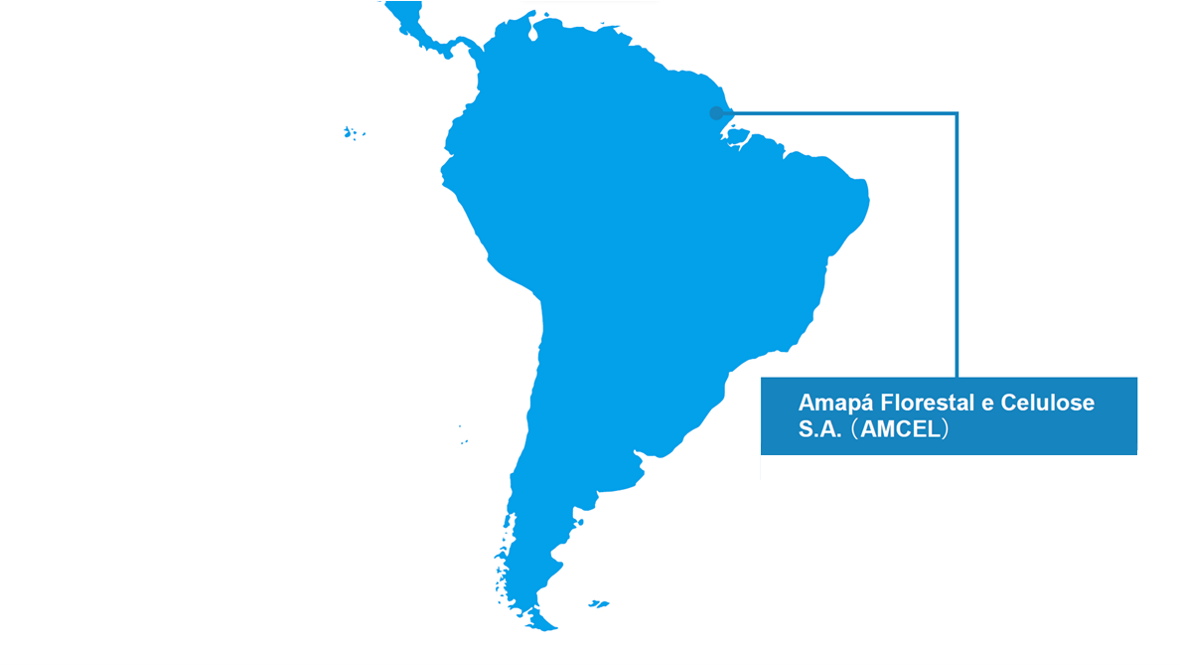
Amapá Florestal e Celulose S.A. (AMCEL)
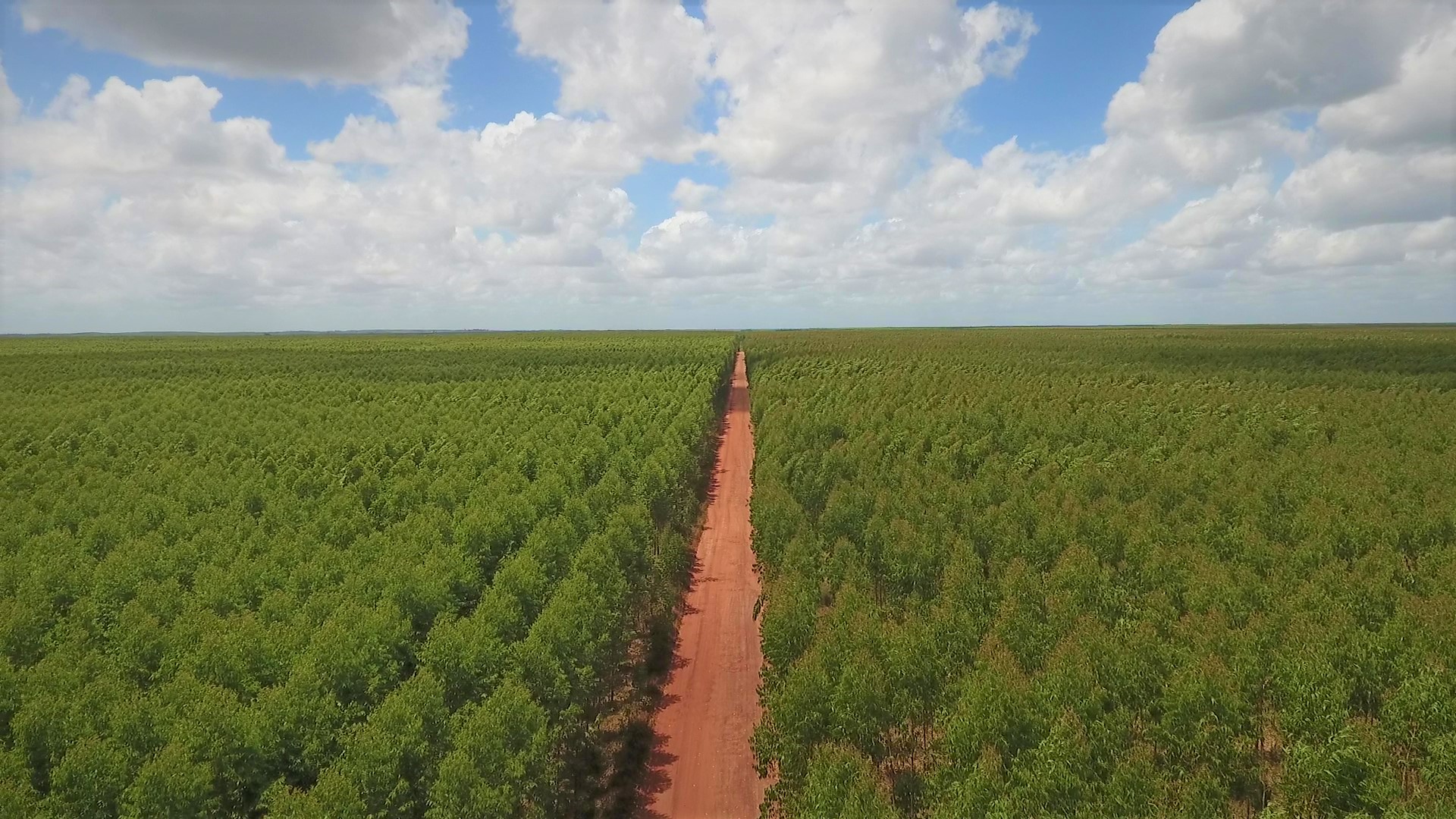
AMCEL is the project with the largest plantation area among Nippon Paper Industries's related businesses, which are engaged in plantation and wood chips export businesses. Currently, Nippon Yusen Kabushiki Kaisha has joined as a partner.
The business is located in the state of Amapa in Brazil. The planted tree species is Eucalyptus urograndis. Currently, Nippon Paper Industries' research department is leading the effort to select and nurture elite trees.
Status of Forest Certification in Overseas Plantation Business
Improving the Productivity of Plantation Areas through Proprietary Technology
The Group is further strengthening its proprietary breeding and propagation technologies to improve forest productivity and improve the efficiency of CO2 sequestration at overseas plantation sites. The Group is further strengthening its proprietary the breeding and propagation technologies to improve forest productivity and improve the efficiency of CO2 sequestration at overseas plantation sites.
Click here for information about the Group's plantation technology
Plantation Cycle
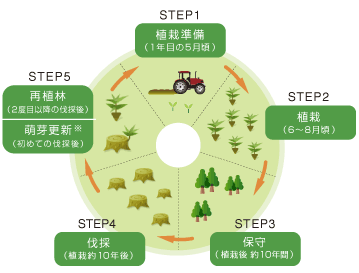
The Company mainly plants eucalyptus at our overseas plantations, but eucalyptus grows to a large enough size for paper production as early as 6 years after planting. Logging is carried out in a planned manner, regenerating forests by planting new plants on the land after logging, or by a method called coppicing, which grows buds from stumps.
Different countries have different ways of planting trees, but here is an example from Australia's 10-year logging cycle.
Plantation Steps
STEP1 Planting Preparation Work (around May of the first year of planting)
Around May, when the rainy season begins, the ground is loosened and tilling work is carried out to create ridges (ridges, streak-like embankments).
As shown in the photo, a device called a mounder is towed by a tractor to stir up the soil and make furrows.
Even within the property, waterways and areas with native vegetation will be protected untouched so as not to affect the local ecosystem. In the nursery, seedlings needed for planting are grown systematically in preparation for shipment during the rainy season.
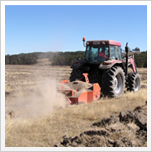
Ridge-making work
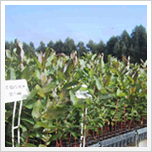
Eucalyptus seedlings waiting for shipment
STEP2 Planting Work (around June-August)
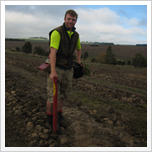
Planting work
Planting is carried out around June-August during the rainy season (which corresponds to winter in Australia). Using planting equipment called planting tubes, each seedling is planted in the row by hand. One person plants 2,000-3,000 seedlings per day, and veterans plant about 6,000-8,000 seedlings.
STEP3 Maintenance Work (after planting - about 10 years)
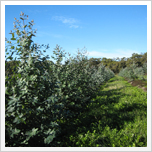
1 year after planting (approx. 2.5m)
The planted seedlings grow quickly in the summer sun. The eucalyptus tree species that we mainly plant in overseas plantations grows 3-4 meters in one year, but it is weak immediately after planting and must be protected from weeds and various pests and diseases. In addition, there is a concern about fires during the dry summer season, and regular patrols are essential for the early detection of various problems.
STEP4 Logging Work (about 10 years after planting)
Trees that have grown to a height of more than 20 meters in about 10 years are cut down using heavy machinery called harvesters.
After the logs are debarked, they are processed into paper wood chips by machines called chippers installed in plantation areas and wood chip mills.
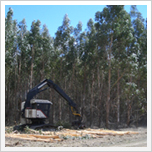
Logging work using harvesters
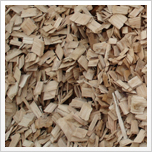
Wood chips (approx. 2-3cm per piece)
STEP5 Update
Usually, the method of renewal differs after the first felling and after the second and subsequent fellings.
After the First Logging: Coppice Regeneration
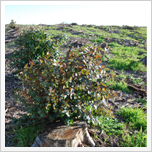
Sprouts from the stump
A tree species called Eucalyptus globulus, primarily planted in Australia and other countries, produces sprouts from stumps after being cut down. We regenerate forests using a method called coppicing, which involves nurturing these sprouts.
After the Second and Subsequent Logging: Replanting
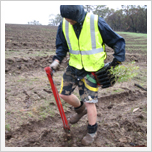
Planting
Usually, after the second logging, forests are regenerated by replanting instead of coppice regeneration. Additionally, if growth was poor during the first logging, or if the tree species, such as acacia, does not readily sprout, regeneration is carried out through planting instead of coppice regeneration.
Overseas Plantation Q&A
-
Why is eucalyptus planted?
-
The purpose of our plantation is to create sustainable forest resources for paper production with our own hands. Therefore, it is necessary to select tree species that grow quickly and have excellent pulping suitability. Eucalyptus is a representative tree species that meets these conditions.
Pulping suitability: Wood chips are digested to produce pulp, which is used as a raw material for paper. Pulping suitability is determined by the ease of digestion and the high yield of wood fibers. Pulping suitability varies greatly depending on the tree species, and it is also known that the suitability of the same tree species can differ depending on its age and planting site.
Tree species used for plantation
・Eucalyptus globulus
It has excellent pulping properties and is planted not only in Australia, where it originates, but also in Chile, which belongs to the same climate zone.・Eucalyptus grandis
Compared to Eucalyptus globulus, they prefer warmer regions.・Acacia melanoxylon
It prefers almost the same growing environment as Eucalyptus grandis. It has excellent pulping properties, and tannins are extracted from its bark. Unlike eucalyptus species, it hardly sprouts after cutting and requires replanting.・Eucalyptus urograndis
It is a hybrid species that is a cross between Eucalyptus urophylla and Eucalyptus grandis.By promoting plantations, we aim to sustainably secure forest resources that are raw materials for paper production without putting a burden on the environment.

Seedlings of Eurograndis
-
Where are the plantations located?
-
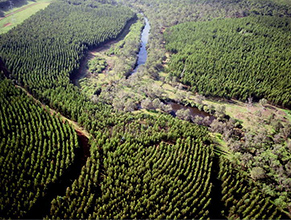
Our afforestation project involves planting trees on former farm and ranch sites, as well as in areas where plantation trees have been felled. The photo shows a plantation in Australia, where you can see that natural forests remain along the water's edge.
In Western Australia, for example, natural forests along the water play an important role in the local environment, such as preventing salt damage. In order not to impair the functions of these natural forests, we are proceeding with the plantation project while fully considering the impact on the environment.
BTP plantation areas
(The inside of the yellow line is the water's edge)
-
What to do with plantation areas after harvesting?
-
Plants have the ability to regenerate. Even after being cut down, buds (dormant buds and adventitious buds) within the plant body will grow, and these buds will continue to develop, eventually forming the main trunk. Such sprouts are called "萌芽" (sprouting), and the regeneration of forests through this process is known as "萌芽更新" (coppice regeneration).
Eucalyptus globulus, in particular, has a strong tendency to sprout, and thus will be regenerated through coppicing. Newly sprouted buds are susceptible to environmental factors and may be damaged by strong winds or frost. In areas where coppice regeneration is not successful, or for tree species that are difficult to sprout, such as acacia, reforestation will be used for renewal.
Sprout from the stump
-
How much does plantation tree grow? (Compared to Japan)
-
The average forest stock volume is around 200 m3/ha for 10-year-old Eucalyptus globulus in Australia, and 200-300 m3/ha for 40-year-old Japanese cedar in Japan.
Comparing this in terms of annual growth, Eucalyptus globulus grows at 20 m3/ha, while Japanese cedar grows at 5-8 m3/ha, indicating a difference of approximately 2 to 4 times.
Domestic Japanese cedar (about 60 years old)

Australian eucalyptus (about 10 years old)