
Promotion of Resource Circulation
In order to build a sustainable society that will be passed on to future generations, it is essential to make effective use of limited resources and realize a circular economy. As a comprehensive biomass company, NIPPON PAPER GROUP has placed the concept of “Three Circulations” as the foundation of its business activities, and promotes both effective use of resources and active recycling.
We have been working with our stakeholders to promote Paper recycling for a long time, and at the same time, we have been working to use resources efficiently and reduce waste throughout the value chain. We will continue to play a role as a member of society that supports the circular economy by creating new circular materials from wood based on the "Three Circulations."
Policy
Based on the philosophy of “NIPPON PAPER GROUP Environmental Charter”, the Group declares its contribution to the formation of a circulation-oriented society and is working to promote the active recycling of resources to realize a circulation-oriented society. In the medium-term environmental management target “NIPPON PAPER GROUP Environmental Targets 2030”, we promote the recycling of resources, and set specific numerical targets to manage progress.
Indicators and Targets
NIPPON PAPER GROUP considers wastepaper as important raw material and is working on the recycling of unused wastepaper. In particular, we have set a goal of increasing the use of unused and difficult-to-treat waste paper to 12,000 tons by FY2030 by operating a recycling facility for food and beverage paper containers capable of producing high-quality, high-white pulp, promoting the use of papermaking raw materials in a wide range of fields such as paper, paperboard, and household paper.
Unused and Difficult-to-Treat Wastepaper Usage
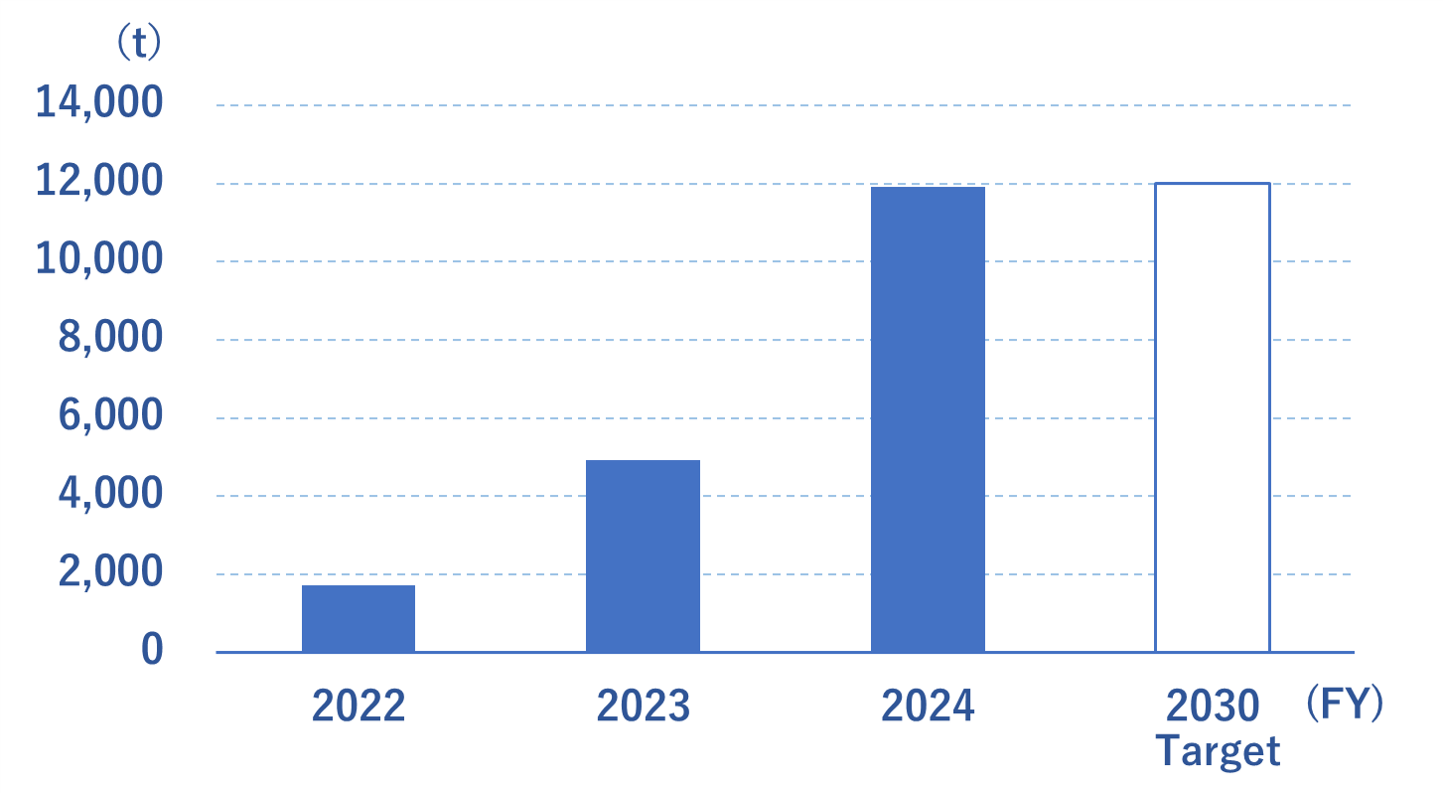
In FY2024, we expanded our recycling activities for difficult-to-treat waste paper, such as used paper cups and release paper, and utilized 11,908 tons of unused and difficult-to-treat waste paper throughout the Group. We will continue to contribute to the construction of a sustainable circulation-oriented society through resource circulation, such as the construction of separate collection and recycling systems, horizontal recycling, and upcycling, and aim to build a new style of business.
Case Study:Launch of Recycling Facilities for Food and Beverage Paper Containers
n 2022, the Company's Fuji Mill began operating facilities dedicated to producing recycled pulp from wastepaper of food and beverage paper containers, and in 2023, the Company began operating shredding and washing plant in the Kanto region. Using wastepaper derived from food and beverage paper containers that have been sorted accurately makes it possible to produce high-quality recycled pulp that has a high degree of brightness. By leveraging the characteristics of recycled pulp produced at this plant and promoting their recycling into various paper products with high added value, the Company will popularize the recycling of used paper containers and build a new resource circulation business.
Case study:Paper Cup Recycling through Three-Company Collaboration with JAL and TOKAN KOGYO
Since 2022, the Company has collaborated with Japan Airlines Co., Ltd. (JAL) to recycle paper cups and other items. The JAL Group properly sorts and collects the paper cups used in some domestic in-flight services, while NIPPON PAPER GROUP provides a unique route for their transportation, accumulation, and packing. This recycling project was initially limited to materials such as containerboards. However, through a three-way collaboration with paper cup manufacturer TOKAN KOGYO CO., LTD., in 2024, the Company became the first in Japan*1 to achieve horizontal recycling, turning paper cups back into paper cups*2.
According to research by the Company
Recycled paper containing used paper cups is used as part of the raw material
Case Study:Recycling of Paper Containers from Restaurants, Sporting Events, and the Like
Since 2024, the Company has collaborated with McDonald's Company (Japan), Ltd., collecting used paper cups from four of its stores in Saitama Prefecture and recycling them.
The Company recycled the paper cups used by roughly 40,000 runners in Tokyo Marathon 2025. Similar recycling efforts are being carried out in marathons nationwide.
The Company has also begun collecting and recycling used paper containers at games played by Alvark Tokyo, a B. LEAGUE professional basketball team. In this way, the Company is working to tackle environmental issues by recycling difficult-to-use wastepaper in various situations and by supplying recycled paper products.
It is also continuing its efforts with Kandu to foster greater awareness among the children who will be responsible for the recycling of the future, aiming to raise future recycling rates.
Case Study:Upcycling Project of Used Paper Containers Centering on "choito®"
In 2024, the Group launched "choito®," a brand of fabric products partially made of paper yarn from used food and beverage paper containers. Through this project, the Company has begun recycling collected used paper containers into high-quality recycled pulp at the Company's Fuji Mill and producing fabric products, such as towels and aprons, using paper yarn created from the pulp. Products with original tags and embroidery have been sold based on requests from Japan Airlines Co., Ltd., Kyobashi-Sembikiya, Ltd., and the UCC Group.
Through this project, the Company is promoting collaboration with many business partners and is helping expand the recycling of used paper containers which were previously disposed of.
Case Study:"Closed Loop" Initiatives
The Company has established a "closed loop" scheme in which it directly purchases wastepaper from its customers in order to make long-term, stable use of collected waste newspaper and catalog paper as a raw material. In April 2023, the Company signed a new contract with DINOS CORPORATION regarding the sale and recycling of wastepaper, for the purpose of domestic circulation of resources by building a "closed loop" of catalog wastepaper, and started operations.
Case Study:Joint Development of Environmentally Friendly Paper Diapers with Kurita Water Industries
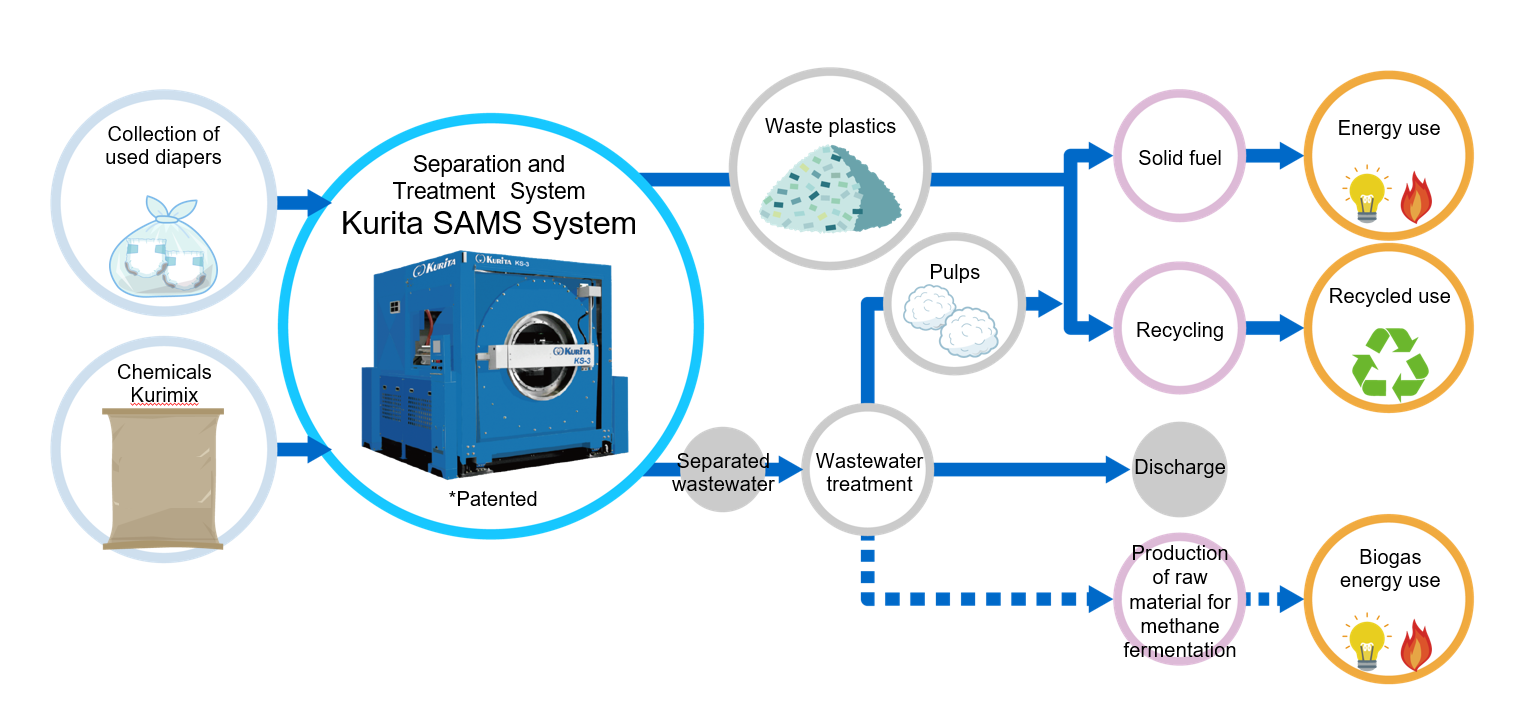
Most of the used diapers in Japan are incinerated in general or industrial waste treatment plants. As Japan's population ages, the volume of used paper diapers is forecast to increase, so there is a rising need to recycle them. Group company Nippon Paper Crecia is developing environmentally friendly paper diapers with Kurita Water Industries Ltd. ("Kurita Water Industries").
In this development project, Nippon Paper Crecia is providing information regarding paper diaper products and Kurita Water Industries is providing information about separation and processing performed using the Kurita SAMS System. Together, they are deliberating product specifications for paper diapers that would increase the quality of separated and processed plastic and pulp materials. Through the project, the companies are helping create a recycling-based economy and society and realize a decarbonized society with the aim of further contributing to societal sustainability.
[Recycling Process Using the Kurita SAMS System]
Case study:Start of Empty Tissue Box Recycling Verification Testing in Soka City
Group company Nippon Paper Crecia has signed an agreement on initiatives for creating a recycling-based society with Soka City, Saitama Prefecture. From April 2024, it has launched an empty tissue box recycling verification project in five public facilities within the city. The collected empty boxes are reused by the Group as raw material for cardboard, and Nippon Paper Crecia is donating toilet paper to elementary schools and junior high schools in the city based on the amount of empty tissue boxes that are collected. Some of the collected boxes are turned into miscellaneous paper storage bags and distributed to elementary schools in Soka City to deepen students' understanding of recycling. Nippon Paper Crecia will continue to strengthen its collaboration, promoting paper recycling and contributing to the realization of a sustainable society.
More information can also be found in the PDF material below.