

Cellulose nanofiber(CNF) Development
The Group has produced many industrial materials that use dissolving pulp, cellulose, lignin, and other wood components without waste through chemical products and functional materials. In addition, in order to open up new possibilities for wood resources, we are expanding the application range from pulping technology to nanotechnology and chemical modification technology, and promoting the development of materials in the biochemical field, such as Cellulose nanofiber (CNF), bioethanol, and bioplastics. CNF is an ultra-fine fiber made from wood-derived fiber (pulp) that has been fibrillated to nano-order (one millionth of a millimeter), and has the characteristics of being light and strong (the elastic modulus is comparable to that of aramid fibers, known for their high strength), as well as excellent properties such as its characteristic viscosity behavior in water and high thermal dimensional stability. Therefore, CNF is expected to be used as a resin reinforcement material for automobiles and electronic devices, as an additive for industrial applications, and as an additive for food and cosmetics.
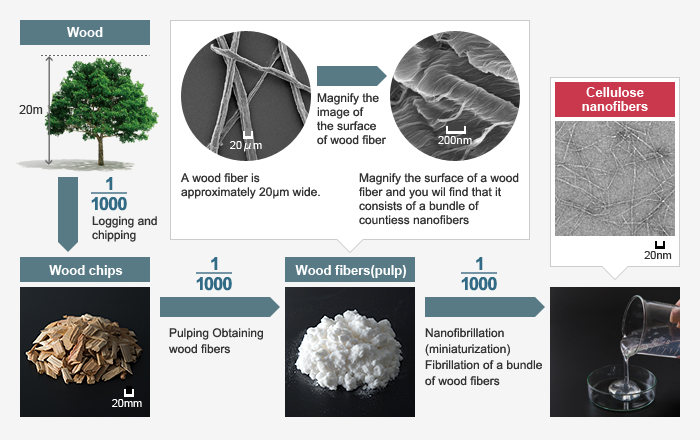
Cellulose nanofiber manufacturing technology and application development
The Company, in order to open up new possibilities for “Wood,” which is a renewable resource, is expanding the range of applications from pulping technology to nano (miniaturization) technology, and is promoting the production and application development of Cellulose nanofiber. The Company manufactures three types of CNFs with properties suitable for their respective applications.
Ishinomaki Mill (Ishinomaki City, Miyagi Prefecture): Mainly for industrial applications, we manufacture CNF with a uniform fiber width of approximately 3 nm from wood pulp chemically treated by the TEMPO catalytic oxidation method (*1).
Gotsu Mill (Gotsu City, Shimane Prefecture): We are manufacturing carboxymethylated CNFs for food and cosmetics applications by applying the manufacturing technology of carboxymethylcellulose (CMC), which is already manufactured and sold as a food additive.
Fuji Mill (Fuji City, Shizuoka Prefecture): We are operating a demonstration production facility for CNF-Reinforced Resin (*2) and are developing manufacturing technology and considering scale-up.
As “a comprehensive biomass company shaping the future with trees,” we will continue to produce CNF stably and create a new market for CNF, which is an innovative material.
*1 A chemical modification method for cellulose by TEMPO catalyst developed by Professor Akira Isogai and his colleagues at the Graduate School of Agriculture and Life Sciences, the University of Tokyo. This makes it easier for nanofibrillation, resulting in uniform width nanofibers.
*2 Resins such as polypropylene (PP), polyethylene (PE), and nylon are kneaded with CNF to add strength.
Features and Applications of Cellulose nanofiber
Due to their shape and characteristic physical properties, Cellulose nanofibers are used in various fields such as mobility, energy storage devices, various industrial products, food, cosmetics, and healthcare.
Features
Light and strong
Ultra-fine fibers (fiber width approx. 3nm)
Large specific surface area
Low thermal expansion
High gas barrier
Exhibits characteristic viscosity in water
Eco-friendly biomass material

Reinforcement
Mixing nanofibers with resin or rubber can improve strength, and enable to develop lighter and stronger parts

Cosmetics
Due to their shape and characteristic physical properties, Cellulose nanofibers are used in various fields such as mobility, energy storage devices, various industrial products, food, cosmetics, and healthcare. CNF has functions suitable for cosmetic applications, such as foam improvement, emulsification and dispersion stability, moisturizing, and a smooth, moisturizing touch.
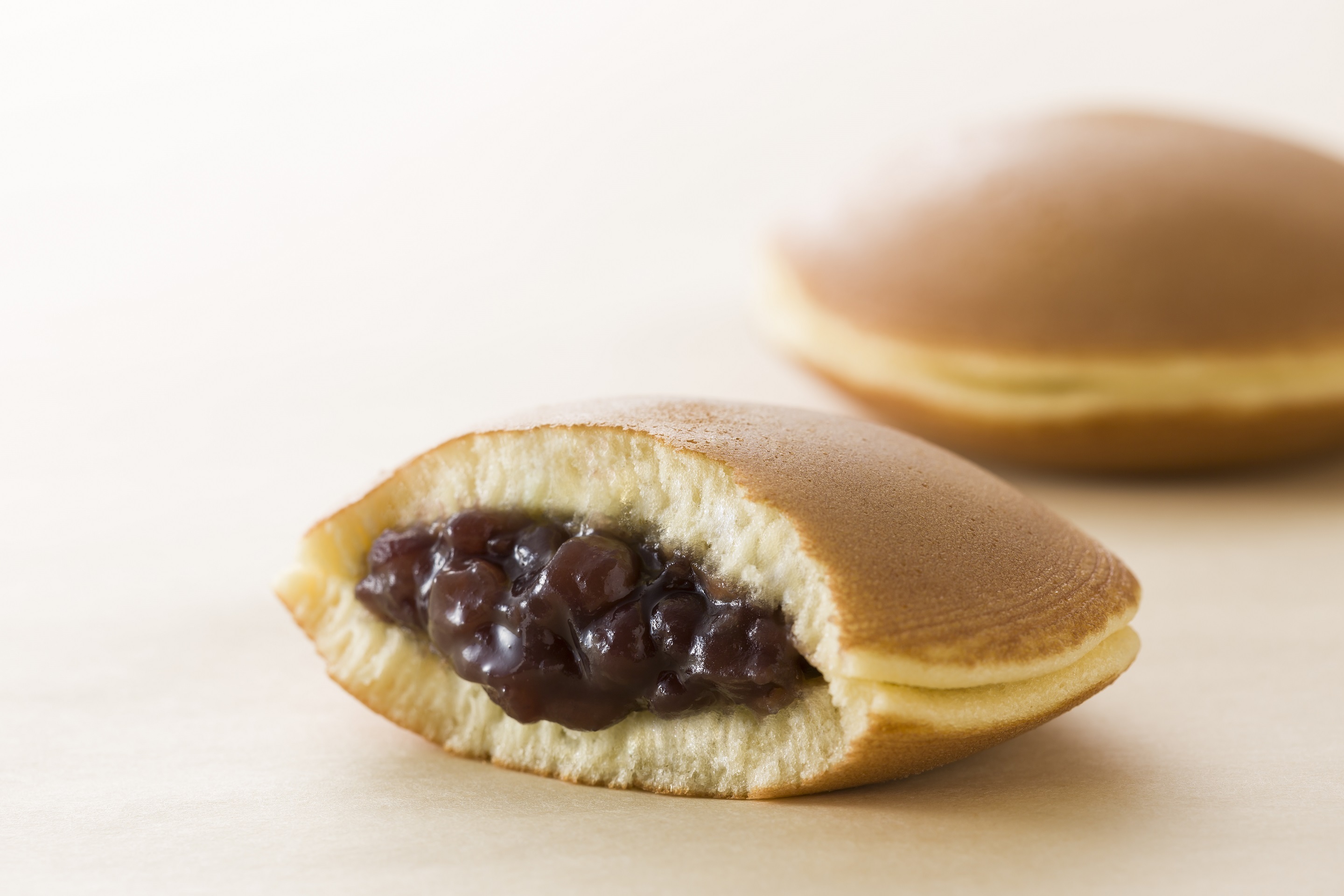
Food
It makes the dough moist and plump, prevents water from separating from jelly and Chinese bun fillings, and contributes to the emulsification and stabilization of creams and dressings.

Industry
As a functional additive for thickening, dispersing, and water retention, it delivers performance surpassing conventional standards, contributing to improved quality of industrial products.
Furthermore, it is possible to develop lightweight yet strong components as reinforcements for rubber and resin.
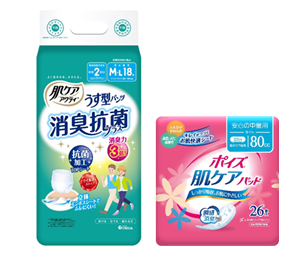
Healthcare
By supporting metal ions on TEMPO oxidized CNF and its raw material, TEMPO oxidized pulp, it can impart deodorizing, antibacterial, and antiviral functions. Utilizing this function, the Nippon Paper Crecia Co., Ltd. Group has commercialized the adult paper diaper “Skin Care Acty™” series and the light incontinence care products “Poise™”.

Materials for future energy storage devices
With a robust nanofiber framework derived from CNF, it achieves a self-supporting membrane that is thin yet easy to handle. Its high electronic insulation contributes to improving the safety and durability of energy storage devices. Furthermore, the ion exchanger introduced into CNF is expected to be applied to electrochemical devices.